
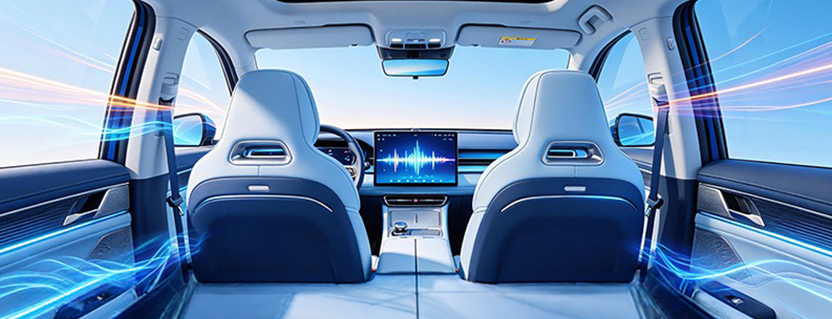
At present, it has become the consensus of the intelligent vehicle industry that car companies should fully deploy the intelligent body of the cabin. Mainstream original equipment manufacturers (OEMs) and Tier 1 suppliers continue to increase the cockpit Agent technology development and implementation, focusing on upgrading the active service capability of intelligent cockpit and the intelligent experience of the whole area, relying on core technologies such as multimodal perception fusion, deep understanding of natural language, end-cloud collaboration and long-term memory, to create a new generation of cockpit interaction system with high anthropomorphism and emotional interaction capability.
A comprehensive upgrade to the cabin experience: emotional interaction and personality awakening
At the interaction level, the underlying breakthrough of large model technology is promoting the evolution of the intelligent cockpit from a single voice command execution device to a cockpit agent with an independent interactive personality and continuous evolution.
1. A revolutionary shift in the voice interaction experience
ASR Automatic Speech Recognition based on Large Models, NLP natural language understanding and TTS emotional voice synthesis technology, cockpit voice interaction from the “rule-based command response” to “natural emotional dialogue” the essence of the leap. It is centrally reflected as: First, it intends to understand generalization, supporting ambiguous semantics, colloquial expressions and complex long sentence parsing; second, the emotional tone is adaptive, and the system can adjust the tone, speed and tone of the voice according to the dialogue scene and the user’s mood dynamics. Thirdly, the multi-round dialogue context is seamless, and the cross-functional domain context is inherited, so that continuous interaction can be completed without repeated wake-up.
2. Multimodal AI capabilities enable immersive emotional interactions.
Relying on AI’s ability to understand through a combination of visual, auditory, and touch modalities, users can describe creative scenarios using natural language, and the system can then integrate voice understanding with AIGC image generation capabilities to quickly render personalized wallpapers and atmosphere-setting scenes. At the same time, the cabin atmosphere lights and audio systems are connected to build an immersive driving experience.
To Auto Omni representing the end-side full-modal large model, multimodal capabilities are further upgraded from “recognition and generation” to “active perception and care.” Through the integration of in-vehicle vision (such as camera recognition of passenger status, left-behind items) and voice emotion analysis, the system can actively provide services such as safety reminders (such as “no mobile phone in the back row”), child protection (automatic lowering of volume and air conditioning when children are asleep), and fatigue warning.
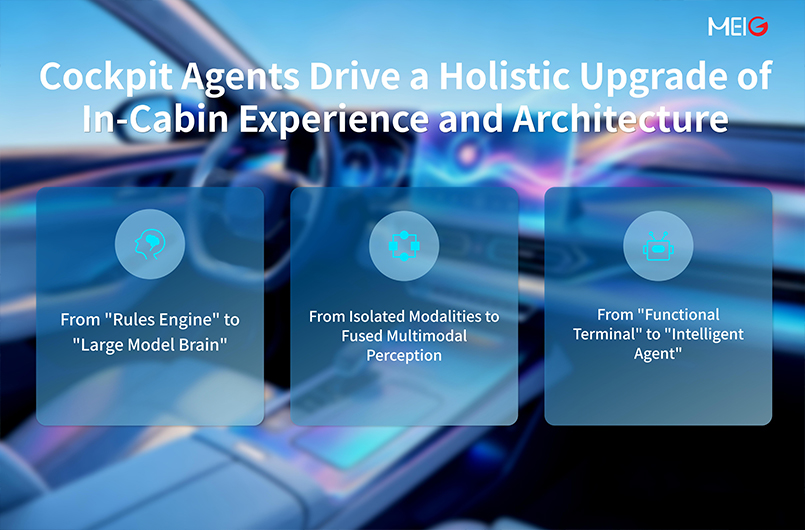
A comprehensive upgrade of cockpit architecture: a paradigm shift from passive response to active perception
At the cognitive architecture level, the autonomous and active nature of Agent drives the intelligent cockpit to open the core transformation from “command executor” to “demand predictor.”
1. Active driving care driven by emotional models
Based on visual perception (DMS / OMS), speech emotion recognition, and multimodal affective computing models, the cabin analyzes multidimensional data such as facial microexpressions, voice tone, and driving behavior to determine user fatigue, anxiety and other states, and automatically implements proactive care strategies such as seat adjustment, ambient light switching, and soothing music play.
2. One-stop intelligent service for cross-domain integration under SOA architecture
Based on the vehicle-based SOA service architecture, AI Agent barriers to service call in the cockpit domain, vehicle control domain, and infotainment domain are broken, enabling a one-stop task execution across applications and domains. Users can issue complex requirements in natural language, and the Agent can complete the whole chain execution of intention disassembly, path planning, service scheduling and payment closed loop, truly realizing “one sentence to complete the whole scene service”.
3. End-cloud converges memory to build personalized, dedicated driving companions
The end side is responsible for the continuous input of visual, voice and environmental information, and the cloud is responsible to make decisions and execute tasks such as driving experience, real-time control and emotional interaction through multiple dedicated Agents, enabling the end-cloud integration of long-term memory and user portrait capabilities.
MeiG Intelligence redefines AI modules, enabling customers to efficiently create cockpit agents.
In response to the rapid industry trend of transforming in-car infotainment systems into AI agents and incorporating emotional interactions, MeiG Smart Technology has taken action. “Connect + calculation + reasoning” emphasizing deep integration, we are redefining AI modules, creating a vehicle-based AI foundation tailored for the era of emotional interaction, providing OEMs and Tier 1 customers with comprehensive support from hardware, software, to ecosystems. This enables the efficient implementation of cockpit agent solutions.
MeiG Smart Redefines AI Modules: Agent Native Vehicle Module 4.0 Standard
As the AI Agent becomes the core of in-vehicle intelligence, MeiG Smart has taken the lead in defining the Module 4.0 standard: the new generation of AI modules is no longer just a simple communication or computing unit but a smart carrier that inherently integrates end-side AI inference capabilities, Agent scheduling systems, and high-speed connectivity capabilities.
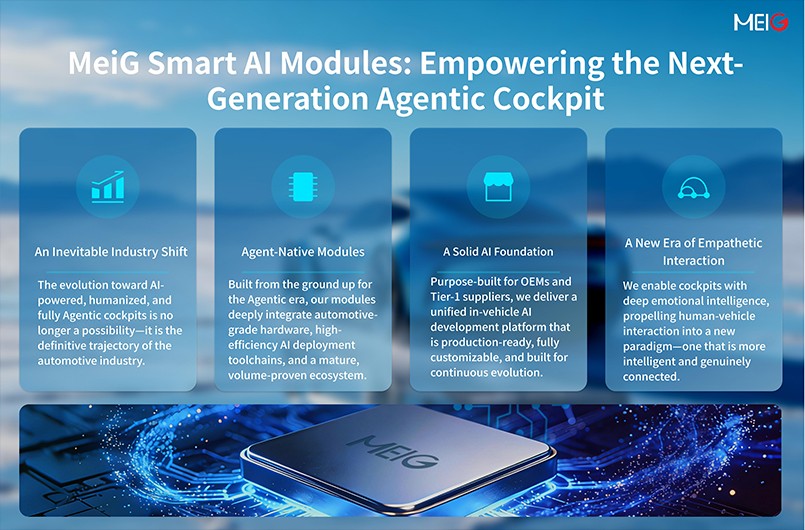
Product Native Compatibility with OpenClaw and other mainstream Agent Harness frameworks to achieve the Agent’s native ability of “local thinking, end-cloud collaboration, and autonomous execution,” so that the cockpit can upgrade from “being able to dialogue” to “being able to think and act” as an emotional partner.
AI BOX Solution: 700 TOPS computing power, out-of-the-box automotive edge unit.
The computing power currently available for mainstream intelligent vehicles is primarily focused on autonomous driving. Car manufacturers seeking to rapidly upgrade the cabin experience find the flexible AI BOX solution to be an exceptionally cost-effective option.
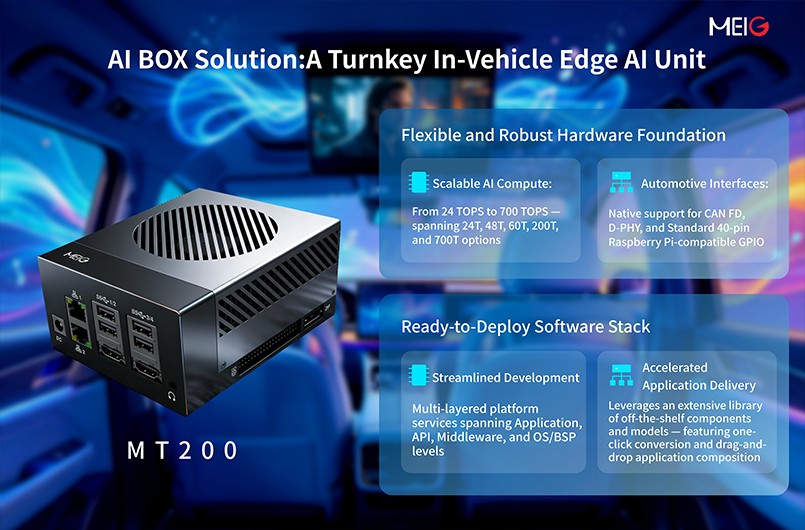
For projects involving rapid intelligent transformation of existing vehicle models or high computational requirements, MeiG Smart provides the MT200 series industrial-grade AI BOX, which offers flexible computational power ranging from 24 to 700 TOPS. It has successfully been adapted to Qwen 7B multimodal models and the OpenClaw framework. At the same time, it has industrial-grade reliability, supports full capacity 7×24 hours, and is equipped with a rich range of on-board interfaces (such as CANFD, D-PHY, etc.), which can be used directly as a high-performance on-board edge computing unit in the vehicle.
Automotive-grade heterogeneous hardware foundation to establish a solid foundation for AI operations.
As the primary computing platform for the cockpit agent, MeiG Smart’s vehicle-mounted AI module employs a multi-core, heterogeneous architecture to meet the stringent requirements of high reliability, low latency, and high concurrency in vehicle applications.
▶ Independent NPU AI Acceleration Engine: Optimized deep operators for automotive ASR, TTS, DMS / OMS, and large-scale model inference, achieving the ultimate AI energy efficiency ratio under automotive-grade power consumption constraints to ensure real-time emotional interaction and multimodal perception.
▶ SoC heterogeneous collaboration: Parallel processing of multi-tasks such as speech recognition, visual perception, AI inference, vehicle communication, network security, etc., to meet Agent multi-thread scheduling and cross-domain service concurrency requirements.
▶ High-speed storage and low-latency bus: Equipped with high-speed storage technologies such as LPDDR5X and UFS 4.0, supporting high-speed reading and writing of large model weights and cabin data; hardware-level low latency data path to achieve millisecond-level command response and emotion feedback.
▶ Vehicle Grade Compliance: Multiple AI module products are developed and manufactured according to AEC-Q104 vehicle grade standard and IATF16949:2016 quality management system, and the industry’s first independent thousand-level dust-free workshop is built for the production and delivery of vehicle grade SIP module.
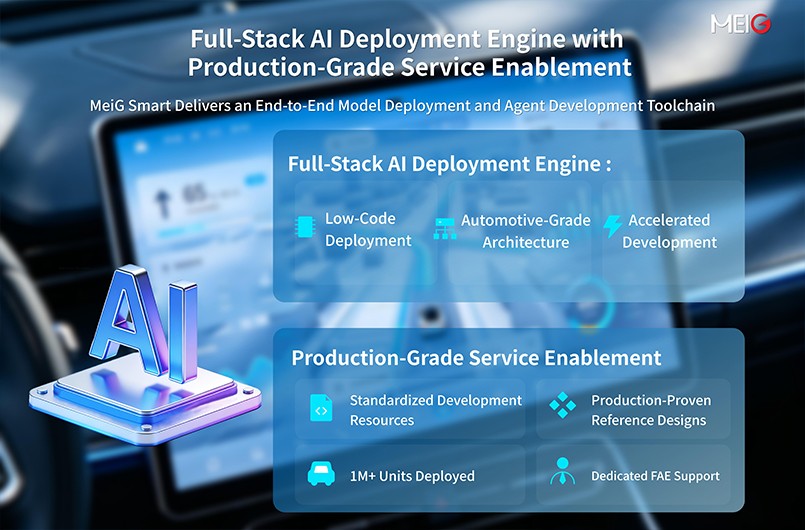
A comprehensive AI deployment engine that significantly reduces the time it takes for intelligent systems to go live.
For the industry pain points of complex deployment of large models on board, long cycle and difficult integration, MeiG Intelligent provides one-stop model deployment and agent development tool chain:
▶ Zero-code AI Quantization Deployment Tool: Support model pruning, distillation, INT4 / INT8 low-bit quantization, visual completion of Qwen, DeepSeek and other mainstream multi-modal big model end-side adaptation, can be quickly deployed without underlying development.
▶ Vehicle-grade end-cloud collaborative architecture: The end-side is responsible for low-latency real-time interaction, the cloud is responsible for deep model evolution and big data training, taking into account response speed and model capabilities, while reducing hardware costs.
▶ Optimized development efficiency: With the Mojo Tools smart agent tool chain and pre-integrated solutions, the development cycle of in-cabin AI can be significantly shortened, helping customers realize product mass production quickly.
In-car development ecosystem and production-grade service support
Based on more than a decade of experience in vehicle communication and AI, MeiG Smart has built a comprehensive vehicle development ecosystem, providing customers with support throughout the entire process, from prototype verification to SOP mass production.
▶ Standardized development resources: Provide hardware manuals, SDK interface documents, large model car adapter guide, and scene-based example code.
▶ Mature reference design: It has the SRM965, SRM975 and other integrated cabin and multi-mode cockpit reference schemes, covering mainstream vehicle scenarios such as multi-screen interaction, DMS / OMS and multi-mode interaction.
▶ Head mass production cooperation experience: Deeply serving mainstream OEM and Tier 1, accumulating millions of vehicles installed, mastering the whole process of vehicle development, testing, certification and mass production, can quickly solve engineering problems.
▶ Exclusive FAE technical support: Provide a one-stop service of demand evaluation, scheme design, joint adjustment test and mass production delivery support.
From passive response to active emotional care, from functional terminals to intelligent companions, the AI-driven, personalized, and agent-like nature of in-cabin systems has become a definitive trend in the industry. MeiG Intelligent Technologies focuses on its Agent native vehicle AI module, which integrates automotive-grade standards, comprehensive AI deployment tools, and a production-level development ecosystem. We are developing production-ready, customizable, and sustainably evolving automotive AI foundations for OEMs and Tier 1 companies, enabling the industry to create truly capable cockpit agents with deep emotional interaction capabilities. Together, we are driving human-vehicle interaction into a new era of emotional intelligence.
Get in touch for orders or any queries: sales@rfdesign.co.za / +27 21 555 8400
Courtesy of MeiG Smart Technology Co., Ltd