
Simplifying GNSS product selection with F11.
Selecting the best fitting product for standard-precision GNSS applications like wearables, asset or vehicle tracking became more complex with the introduction of L1/L5 dual-band variants. Trade-offs between position accuracy, power consumption, unique features, and HW integration had to be considered before the final product decision. Especially when looking at L1 single-band and L1/L5 dual-band GNSS products, previously designers had to choose between urban performance and low power consumption, managing dedicated product variants and different firmware versions. As a result, complexity grew.
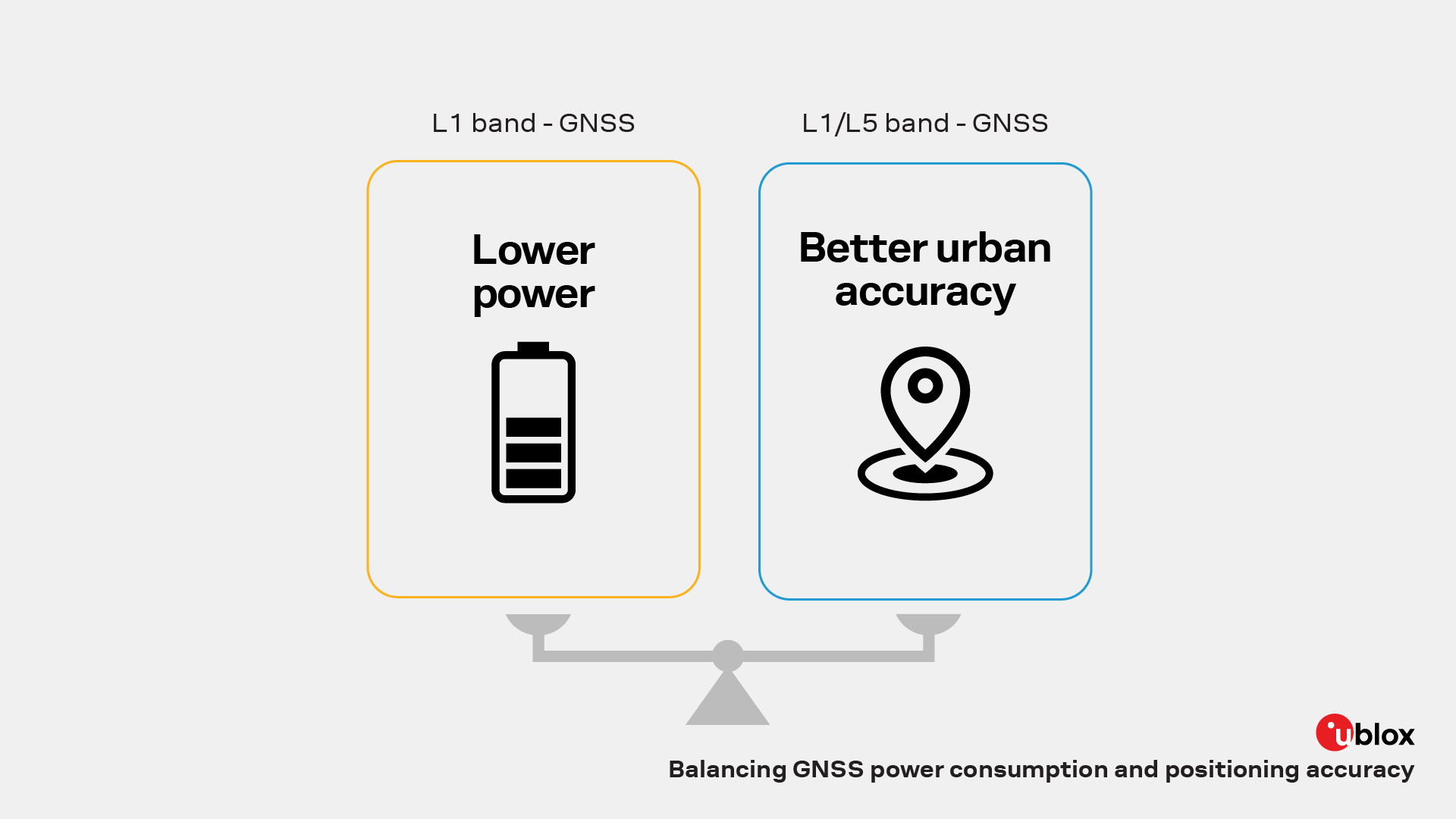
For some use cases like wearables or vehicles tracking, which for many years were using L1 single-band GNSS and now slowly adopting L1/L5 dual-band use, it meant creating two different products using different GNSS chips or modules with different firmware variants. This led to reduced flexibility in offering a single solution to their customers.
| u-blox platform | U-BLOX M10 | U-BLOX F10 | U-BLOX F11 |
|---|---|---|---|
| Band support | L1 | L5 | L1 or L1/L5 |
| Firmware for wearables use cases | SPG 5.21 | n/a | SPG 7.00 |
| Firmware for all other use cases | SPG 5.10 SPG 5.30 | SPG 6.00 | SPG 7.00 |
| Power saving features | LEAP | n/a | LEAP Selective L5 |
| Chip power consumption | 10-15 mW | 35 mW | 7-23 mW |
Table: u-blox F11 combines the feature set of u-blox M10 and F10
u-blox’s F11 platform reimagines this approach by introducing a unified GNSS platform. It offers a single architecture, one firmware baseline, and a unified feature set that combines the benefits of previous L1 single-band and L1/L5 dual-band platforms.
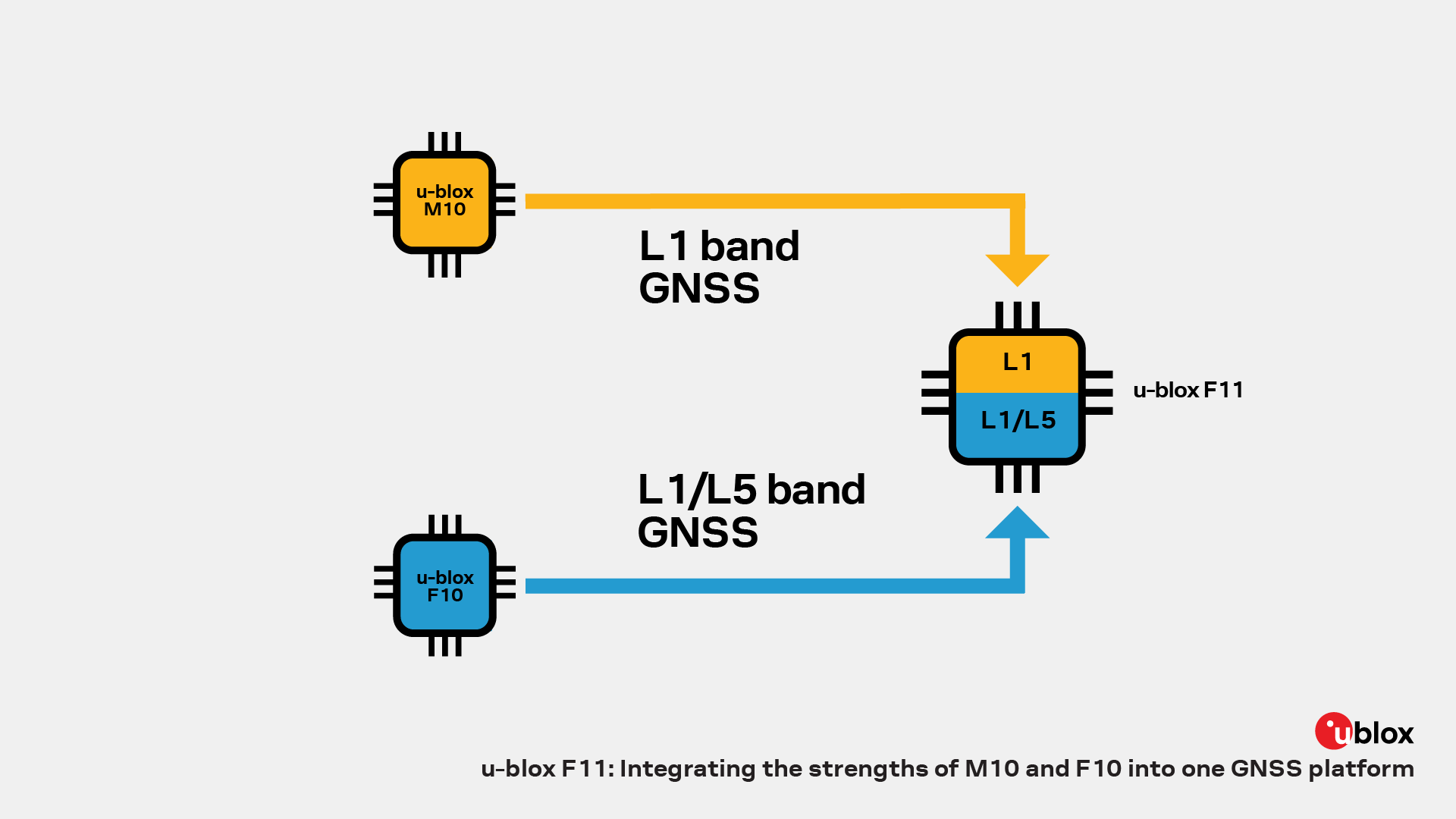
A key innovation is its Selective L5 technology. The platform uses L1 signals in an open sky environment and autonomously activates the L5 band only when needed – such as in dense urban areas. This delivers meter-level accuracy in all environments while reducing power consumption whenever possible.
The platform supports a wide range of use cases, including asset tracking, wearables, telematics, micromobility, and drones, from a single hardware design. It achieves this through support for both single- and dual-band operation, application-specific modes, and firmware upgradeability.
F11 also simplifies the design process. A single hardware design can cover multiple performance tiers, while a unified firmware environment reduces integration effort.
By consolidating features into one platform, u-blox’s F11 platform enables faster prototyping, reduced validation effort, making it ideal for high-volume, scalable applications.
u-blox F11 products like the UBX-F11270-KB chip and the MAX-F11/M11series are pin compatible with their predecessor products UBX-M10, UBX-F10 and MAX-M10 / MAX-F10 series.
Get in touch for orders or any queries: sales@rfdesign.co.za / +27 21 555 8400
Courtesy of u-blox