
Explore the important attributes, benefits, and real-world uses of Wi-Fi HaLow that stand poised to transform connectivity across multiple industries, establishing it as a crucial component for contemporary technological advancements.
Wi-Fi HaLow serves as a specialized wireless protocol designed specifically for Internet of Things (IoT) use cases. Functioning below the 1 GHz frequency band, this technology surpasses conventional Wi-Fi in its ability to transmit over greater distances and through barriers more effectively. Explore the important attributes, benefits, and real-world uses of Wi-Fi HaLow that stand poised to transform connectivity across multiple industries, establishing it as a crucial component for contemporary technological advancements.
While Wi-Fi is the de-facto standard for the vast majority of WLAN applications, it’s not suitable for every kind of wireless connectivity. In particular, Wi-Fi’s range is somewhat mid-range by comparison to other standards. Bluetooth covers short range communications well, and Wi-Fi can blanket larger areas such as whole homes or public venues with the aid of multiple access points. But it doesn’t servethe large, multi-mile ranges that might be services by technologies like cellular/LTE.
This is partially due to the frequency ranges in use, which are somewhat vulnerable to destructive interference from solid structures and the natural propagation loss that occurs over long distances. The solution to this is to deploy Wi-Fi technology in a frequency range that penetrates surfaces and reaches long ranges with more efficiency. A trade-off is possible that lowers the ultra-high data transfer that Wi-Fi is known for in exchange for better reliability , longer range, and more connected devices on a single access point.
Wi-Fi HaLow is a technology engineered to meet the expansive needs of IoT, drawing on the capabilities defined by IEEE 802.11ah specifications. This variation of Wi-Fi operates in lower frequency bands—in the United States, it utilizes the 900 MHz frequency range that doesn’t require licensing or permits— which we refer to as sub-GHz bands. Thanks to its distinctive operating frequency, Wi-Fi HaLow boasts an extensively long range and superior penetration through obstacles compared to standard Wi-Fi.
Tailored for IoT environments, this innovation enables communication across greater distances while keeping energy usage low. Unlike traditional Wi-Fi, which uses channel widths of 20 MHz typically, Wi-Fi HaLow works with channels as narrow as 1 MHz. The reduced channel width significantly aids in carrying Wi-Fi signals farther away thus making it ideal for various IoT applications.
Wi-Fi HaLow transcends being merely another Wi-Fi version within the broader scope of wireless connectivity. Instead, it marks a notable advancement tailored specifically for connected devices within IoT networks. This strategic shift surmounts some key challenges faced by conventional Wi-Fi setups and paves way for groundbreaking possibilities in establishing stable and efficient connections appropriate for diverse Internet-of-Things (IoT) use cases
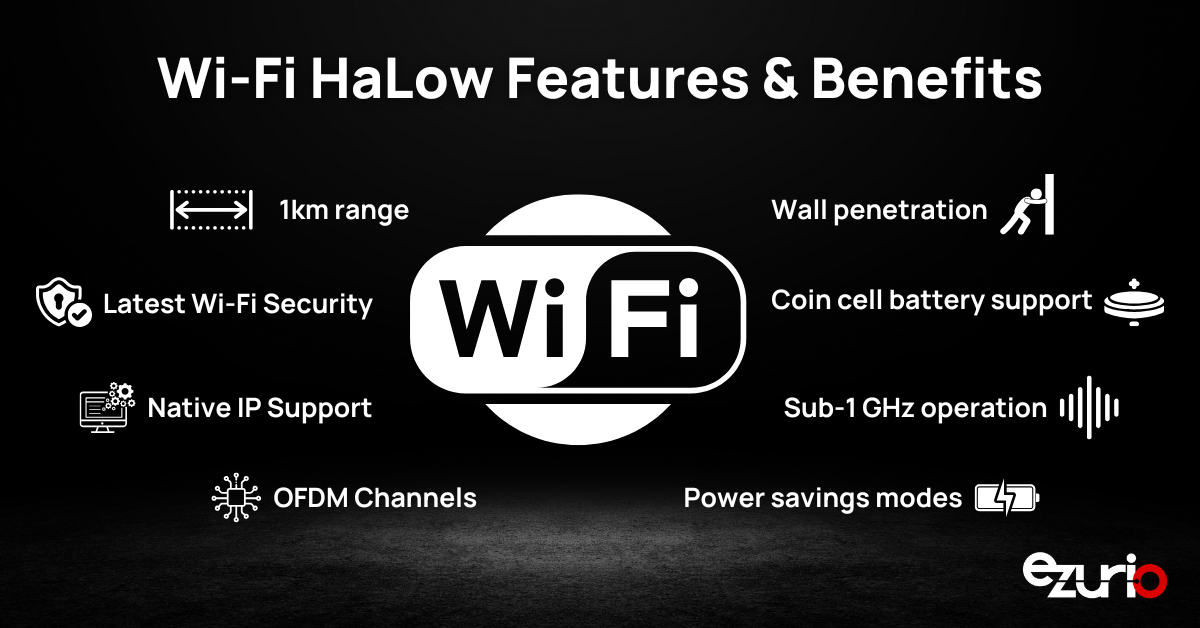
Wi-Fi HaLow, operating in the sub-1 GHz band, delivers superior signal penetration and has a potential reach beyond 1 kilometer, significantly outstripping traditional Wi-Fi that operates at 2.4 GHz. This increased distance capability is particularly beneficial for scenarios requiring long-range connectivity like those found in smart city setups or industrial IoT configurations.
Wi-Fi HaLow widens the Association ID (AID) field from 11 bits to 13 and adds a hierarchical AID structure, raising the theoretical ceiling from 2,007 stations per access point in legacy Wi-Fi to 8,191 in 802.11ah. That is an addressing limit, not a performance guarantee. Practical density depends on traffic pattern, beacon interval, and how aggressively the network uses Restricted Access Window grouping; production access points and reference designs today are validated in the hundreds of concurrent clients, with the reference hostapd configuration defaulting to 255. For most sensor deployments the constraint that bites first is airtime, not address space.
Rather than supplanting existing Wi-Fi standards, Wi-Fi HaLow serves as an extension designed to broaden connectivity while circumventing the need for numerous access points or intricate cabling systems. It’s for very different applications than traditional wi-fi protocols. Its efficiency benefit is furthered by facilitating various advanced low power modes which allow connected IoT devices to maintain battery life effectively.
FunctionWi-Fi 4 / 5 / 6 IEEE 802.11n/ac/ax)Wi-Fi Halow (IEEE 802.11ahOperating Frequency2.4 GHz, 5GHz, 6 GHz (6E)Sub-1 GHz (850 – 950 MHz)Channel width choices20, 40, 80, 160 MHz1, 2, 4, 7, MHzMax Addressable STAs per AP20078191Single Stream MCS data rate6.5 Mbps-150 Mbps150 Kbps – 43.3 MbpsTypical rangeApproximately 100 meters10x longer than 802.11n 20 MHz
Wi-Fi HaLow takes the OFDM design of 802.11a/g and downclocks it by a factor of ten. Subcarrier spacing drops from 312.5 kHz to 31.25 kHz, which is what allows a channel as narrow as 1 MHz to carry a usable OFDM waveform. Symbol duration stretches to 36 or 40 microseconds, including a 4 or 8 microsecond guard interval, which also makes the signal more tolerant of the longer delay spreads found on kilometer-scale outdoor links.
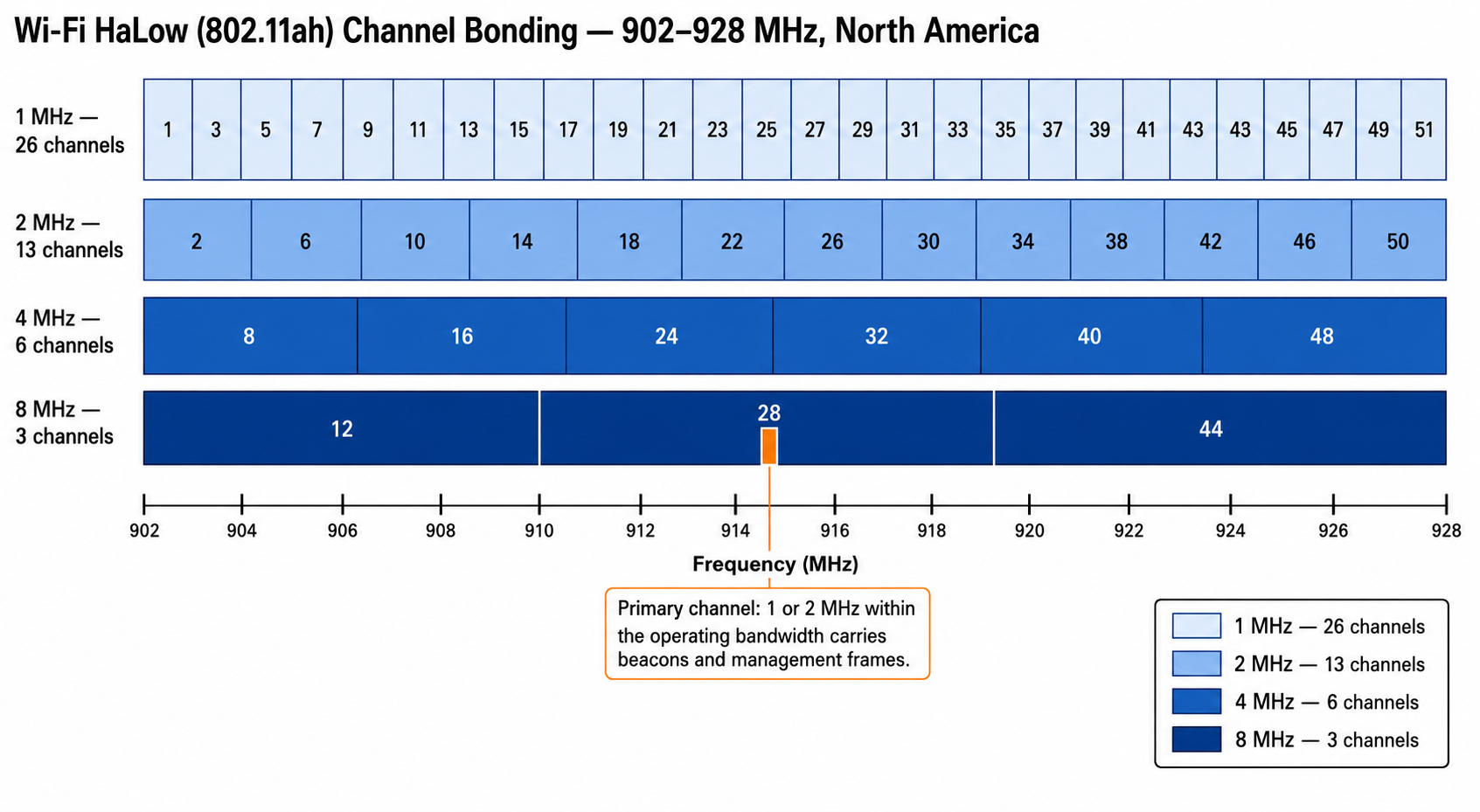
Channels bond upward from that 1 MHz base: 1, 2, 4, 8, and 16 MHz. Data subcarriers scale accordingly, with 24 at 1 MHz, 52 at 2 MHz, 108 at 4 MHz, and 234 at 8 MHz. In North America the 902–928 MHz ISM band accommodates 26 non-overlapping 1 MHz channels, 13 at 2 MHz, 6 at 4 MHz, and 3 at 8 MHz. Most shipping silicon today supports up to 8 MHz; 16 MHz is defined in the standard but rare in the market.
Every HaLow network also designates a primary channel of 1 or 2 MHz within its operating bandwidth. Control and management traffic, including beacons, rides on the primary channel so that narrowband stations can participate in a wideband network. This is why a 1 MHz sensor and an 8 MHz camera can share the same access point.
The channel width choice is the single most consequential decision in a HaLow deployment. Narrow buys range and device density; wide buys throughput. The relationship is quantified in the link budget section below.
Vendors quote 10× the range of conventional Wi-Fi. The number is derived, not measured, and the derivation is worth showing because it also tells you when the claim will not hold.
Two effects contribute.
Narrower channels lower the noise floor. Thermal noise power scales with bandwidth: the noise floor equals −174 dBm/Hz plus 10·log₁₀(bandwidth in Hz). A 20 MHz Wi-Fi channel sits at roughly −101 dBm. A 1 MHz HaLow channel sits at roughly −114 dBm. Because a given modulation requires a given signal-to-noise ratio regardless of bandwidth, a 1 MHz receiver can decode a signal 13 dB weaker than a 20 MHz receiver can.
Lower frequencies lose less energy in free space. Free-space path loss in dB equals 20·log₁₀(d) + 20·log₁₀(f) + 32.44, with distance in kilometers and frequency in MHz. At the same distance, 915 MHz suffers about 8.5 dB less loss than 2.437 GHz.
Combined, that is roughly 21.5 dB of additional link budget. Working it through with equal transmit power and antenna gain: a 20 MHz Wi-Fi link with an MCS0 sensitivity near −94 dBm and 20 dBm transmit power tolerates about 114 dB of path loss, which is about 4.9 km in free space. A 1 MHz HaLow link with sensitivity near −107 dBm tolerates about 127 dB, which is about 58 km in free space. The ratio is roughly 12×, and that is where the 10× figure originates.
Now the caveat that vendor pages omit. Free space is a path loss exponent of 2. Real deployments run at exponents of 3 to 4 once you add ground reflection, foliage, and buildings, and the sensitivity advantage converts to range far less generously. Under an exponent of 3, the same 13 dB of receiver sensitivity buys about 2.7× the distance rather than 4.5×. That is why field trials report a kilometer rather than fifty. The frequency advantage in penetration through concrete, soil, and vegetation, which is real and substantial, is what makes up much of the difference in practice.
The correct way to read the claim: HaLow gives roughly 20 dB more link budget than 2.4 GHz Wi-Fi at the same power. What that converts to in meters depends entirely on the environment, and the only honest answer for your site is a measurement.
Wi-Fi HaLow is gaining recognition for its multitude of benefits, positioning it as a superior option for upcoming IoT network generations. Thanks to its operation in the low-frequency spectrum, Wi-Fi HaLow offers robust obstacle penetration and expansive reach. Such attributes prove invaluable where traditional Wi-Fi networks falter due to physical blockades.
By leveraging sub-GHz frequencies, Wi-Fi HaLow enhances its ability to navigate through walls and other obstacles while reducing congestion and minimizing interference, all essential factors for widespread IoT applications that depend on consistent connections free from disturbances. The introduction of features like Target Wake Time (TWT) also plays a pivotal role in achieving low power draw on connected devices.
The frugal energy demands of Wi-Fi HaLow are transformative for battery-dependent devices by substantially prolonging their usable lifespans. This trait is particularly important for those IoT items placed within areas where replacing batteries frequently isn’t feasible or convenient. This technology has the capability to manage thousands of Wi-Fi device connections at once without causing network overload.
Finally, the scalability offered by Wi-Fi Halow stands out. It can seamlessly connect an extensive number of devices utilizing a single access point—a factor that streamlines installation processes and cuts down long-term costs relative to alternative IoT solutions currently available. As more individuals become acquainted with these advantages, there’s anticipation that WiFi Halow will emerge as a top selection among next-gen IoT networks because it smoothly integrates with pre-existing WiFi setups.
The claim that one access point can serve thousands of devices raises an obvious problem. Standard Wi-Fi uses CSMA/CA, where every station listens and then transmits when the channel appears free. Put a thousand sensors on one channel and they collide constantly; throughput collapses long before you reach the addressing limit.
802.11ah solves this with the Restricted Access Window. The access point divides its associated stations into groups and advertises, in the beacon, a series of time windows. During a given window, only stations belonging to that window’s assigned group may contend for the channel. Every other station stays quiet.
Two things follow. Contention drops because at any instant only a fraction of the network is competing. Battery life improves because a station knows in advance that it has no business on the air until its window arrives, so it can sleep through everyone else’s.
RAW also addresses the hidden-node problem that plagues large sub-GHz deployments. When an access point covers a kilometer, stations on opposite edges of the cell cannot hear each other and will happily transmit over one another. Grouping stations so that mutually hidden nodes land in different windows removes those collisions structurally rather than relying on RTS/CTS handshakes.
RAW is the mechanism that turns high device density from a specification number into a working network. When you evaluate access points, ask how RAW grouping is configured and whether the vendor exposes it.
802.11ah splits power-saving stations into two classes, and the distinction determines how long a battery lasts.
TIM stations follow the classic Wi-Fi model. The access point maintains a Traffic Indication Map, a bitmap in the beacon showing which sleeping stations have buffered downlink traffic waiting. A TIM station wakes on a schedule, reads the beacon, checks its bit, and either retrieves its data or goes back to sleep. It works, but it costs a beacon reception on every cycle, and with thousands of stations the TIM element itself becomes large. 802.11ah adds page slicing to segment the bitmap so a station only parses the portion relevant to it.
Non-TIM stations skip beacons entirely and use Target Wake Time. The station and access point negotiate specific future instants at which the station will wake, along with an expected activity duration. Between those instants the station is unreachable by design and can sit in deep sleep for minutes, hours, or days. There is no periodic beacon overhead at all.
The trade-off is latency. A TIM station can receive downlink traffic within one beacon interval. A non-TIM station using a one-hour TWT interval cannot be reached until its next wake time. Choose TIM for anything that must accept a command promptly, such as a lock, valve, or actuator. Choose non-TIM with TWT for pure telemetry, where the device reports and nothing needs to reach it in between.
TWT was successful enough in 802.11ah that it was carried forward into Wi-Fi 6, where it now saves power on mainstream client devices.
A station at the edge of a HaLow cell can associate, but only at the lowest modulation and coding scheme, which means it occupies the channel for a long time to send very little. That single distant sensor consumes airtime that dozens of nearer stations could have used, and it burns its own battery keeping the radio active through a slow transmission.
802.11ah defines a Relay, an entity that is logically both an access point and a station. Distant stations associate with the relay instead of the root access point. Because the hop to the relay is short, both legs of the path run at a high MCS. Total airtime consumed drops even though the frame now traverses two hops, and the edge station’s radio-on time falls sharply.
The standard constrains this deliberately. Relaying is bidirectional and limited to two hops. That ceiling exists because each hop adds latency and duplicates airtime; an unbounded relay tree would consume more capacity than it recovers. If your topology needs arbitrary depth, 802.11s mesh is the tool, at the cost of mesh’s own overhead.
Practically, a relay is the right answer when you have a small number of stations sitting past the point where the link rate falls off a cliff. It is the wrong answer when coverage is uniformly marginal, in which case you need a second access point, a higher-gain antenna, or a higher-power radio.
Sectorization partitions the coverage area of a single basic service set into angular sectors, using either separate directional antennas or synthesized beams, with a subset of stations assigned to each.
Two problems get smaller. Within the cell, stations in different sectors no longer contend against each other for the same airtime, which compounds with RAW grouping. Between cells, neighboring access points covering overlapping areas can point energy away from one another, allowing spatial reuse of the same channel in deployments where the 26 available 1 MHz channels are already spoken for.
Sectorization matters most in the deployments HaLow is best at: a farm, a rail yard, a campus, anywhere a single mounting point serves a wide area with stations distributed unevenly around it. It matters least indoors, where multipath scatters energy in all directions regardless of what the antenna intended.
Every time a station wins channel access it has paid a cost: backoff time, contention risk, and the energy to keep its receiver listening. Under standard rules, an uplink frame and its downlink response are two separate contention events.
Bidirectional TXOP lets an access point and a station exchange a continuous sequence of uplink and downlink frames inside a single reserved transmit opportunity. Once the pair owns the channel, they use it in both directions before releasing it. The feature was called Speed Frame Exchange in earlier drafts of the standard.
The benefit compounds for the request-response traffic typical of IoT. A sensor that reports a reading and receives an acknowledgment plus a configuration update completes the whole exchange in one wake period rather than three, then returns to sleep. Fewer contention events also means less collision risk across the whole cell, so the gain is not just per-device.
Wi-Fi HaLow defines eleven modulation and coding schemes. The table below gives calculated single-stream PHY rates for the four channel widths in common commercial use, at both long (8 µs) and short (4 µs) guard intervals.
| MCS | Modulation | Coding rate | 1 MHz (Mbps) | 2 MHz (Mbps) | 4 MHz (Mbps) | 8 MHz (Mbps) | ||||
|---|---|---|---|---|---|---|---|---|---|---|
| Long GI | Short GI | Long GI | Short GI | Long GI | Short GI | Long GI | Short GI | |||
| 0 | BPSK | 1/2 | 0.30 | 0.33 | 0.65 | 0.72 | 1.35 | 1.50 | 2.93 | 3.25 |
| 1 | QPSK | 1/2 | 0.60 | 0.67 | 1.30 | 1.44 | 2.70 | 3.00 | 5.85 | 6.50 |
| 2 | QPSK | 3/4 | 0.90 | 1.00 | 1.95 | 2.17 | 4.05 | 4.50 | 8.78 | 9.75 |
| 3 | 16-QAM | 1/2 | 1.20 | 1.33 | 2.60 | 2.89 | 5.40 | 6.00 | 11.70 | 13.00 |
| 4 | 16-QAM | 3/4 | 1.80 | 2.00 | 3.90 | 4.33 | 8.10 | 9.00 | 17.55 | 19.50 |
| 5 | 64-QAM | 2/3 | 2.40 | 2.67 | 5.20 | 5.78 | 10.80 | 12.00 | 23.40 | 26.00 |
| 6 | 64-QAM | 3/4 | 2.70 | 3.00 | 5.85 | 6.50 | 12.15 | 13.50 | 26.30 | 29.30 |
| 7 | 64-QAM | 5/6 | 3.00 | 3.34 | 6.50 | 7.22 | 13.50 | 15.00 | 29.30 | 32.50 |
| 8 | 256-QAM | 3/4 | 3.60 | 4.00 | 7.80 | 8.67 | 16.20 | 18.00 | 35.10 | 39.00 |
| 9 | 256-QAM | 5/6 | not defined | 8.67 | 9.63 | 18.00 | 20.00 | 39.00 | 43.33 | |
| 10 | BPSK, 2× repetition | 1/2 | 0.15 | 0.17 | not defined | not defined | not defined | |||
Long GI = 8 µs guard interval. Short GI = 4 µs guard interval. Rates are calculated single-stream PHY rates; measured application throughput is lower.
MCS10 is the most interesting entry and the least discussed. It exists only at 1 MHz and transmits each bit twice using BPSK with rate-1/2 coding. The repetition buys roughly 3 dB of additional link margin at the cost of halving throughput to about 150 kbps. It is the mode that keeps a link alive after MCS0 has failed, and it is why HaLow’s practical coverage edge extends beyond where the rate table appears to stop. If you are specifying a deployment where a handful of nodes sit at the far edge and report only a few bytes, MCS10 is the reason you may not need a second access point.
Note also that MCS9 is not available at 1 MHz. The 24 data subcarriers available in a 1 MHz channel cannot support 256-QAM at rate 5/6 within the standard’s framing.
802.11ah is not the only sub-1 GHz member of the 802.11 family. IEEE 802.11af, sometimes called White-Fi, operates in the TV white space spectrum between 54 and 790 MHz in the VHF and UHF bands.
The difference that matters is regulatory rather than technical. 802.11af operates in bands licensed to broadcasters, so devices must use cognitive radio techniques: query a geolocation database, confirm which channels are unoccupied at their position, and vacate on demand. That dependency on a database service and a geolocation fix adds cost, latency, and a permanent external dependency to every device.
802.11ah operates in license-exempt ISM spectrum with no database, no coordination service, and no incumbent to yield to. For self-deployed IoT networks that difference has decided the market; 802.11af has seen minimal commercial deployment while HaLow silicon ships in volume.
Wi-Fi HaLow technology is capable of sustaining connections over distances up to three kilometers under ideal circumstances, making it well-suited for smart city environments that demand widespread coverage. One example case is a smart city pilot in Irvine, California, where Wi-Fi HaLow secured a coverage radius of one kilometer up to 1.5 miles along Irvine Center Drive (with PHY rates to 3.34 Mbps) and supported functions such as smart building control, security cameras, and tracking assets.
In the context of industrial settings, Wi-Fi HaLow has proved its mettle by delivering both suitable transfer speeds and steadfast connectivity across considerable ranges. For instance, within a sizable Tampa-based industrial facility, the technology sustained sufficient data rates and consistent connectivity at distances reaching 425 feet — crucial for monitoring low power assets accurately in real time. These tests underscore the durability and dependability of this tech amidst strenuous conditions.
It’s important to note that Wi-Fi HaLow provides slower speeds than conventional Wi-Fi networks based on standards such as Wi-Fi 6 and 6E. Depending on the configuration, HaLow can provide rates from 15 Kbps to 15 Mbps, a far cry from the 9.6 Gbps maximum of Wi-Fi 6E. However, for the kinds of applications that Wi-Fi HaLow targets, these data rates are sufficient to provide critical wireless connectivity in sensor applications, industrial connectivity, smart city environments, and more.
By circumventing crowded frequency bands like 2.4GHz and 5GHz ones, Wi-Fi HaLow guarantees stable connection paths essential for vital low power IoT use cases. The reach of this technology spans various domains from domestic automation to agriculture through to industry-grade utilization. Trials including those conducted at Newracom Office Park have exemplified its capacity to maintain comprehensive multi-level building coverage through varied materials including metal thermal energy–blocking films on glass while handling energy governance systems along with security services efficiently. This kind of implementation supports smart building applications across a large area with great efficiency and high performance where line of sight cannot be achieved.
Wi-Fi HaLow support continues to grow thanks contributions via chipset advancements, strategic alliances forged within businesses in the healthcare and logistics sectors, and other exploratory development. The massive device count supported by HaLow resolves scalability concerns associated with large-scale initiatives, and its ability to maintain connection over long range open-air deployments has made it a promising option for rural connectivity.
Wi-Fi HaLow enhances the Internet of Things (IoT) landscape by supporting a greater number of devices per network than traditional Wi-Fi. This technology blends seamlessly with pre-existing IoT technologies, providing sturdy and expandable solutions ideal for smart city environments among other IoT applications.
To alternative connectivity options within the IoT domain, Wi-Fi HaLow distinguishes itself in numerous aspects. With an impressive capacity to accommodate up to 8,191 devices—dwarfing Z-Wave’s Long Range which supports a maximum of 2,000—and significantly outpacing Thread’s approximate limit of 250 connections, Wi-Fi HaLow notably excels. This technology strikes a harmonious equilibrium between maintaining low power and transferring substantial data payloads efficiently.
While Zigbee provides faster data rates compared with those offered by Wi-Fi HaLow, it falls short on scope and design flexibility because its functioning depends heavily upon a central coordination node. Incorporating cutting-edge security protocols such as WPA3 encryption solidifies Wi-fi HaLow’s position not just as secure but also reliable when facilitating communications between connected apparatuses—an indispensable benefit in today’s complex spheres governed by various interconnected technologies within modern IoT settings.
Both routers and devices must support Wi-Fi HaLow standards, meaning older hardware cannot be upgraded to this technology. Manufacturers are developing Wi-Fi extenders with HaLow capabilities, enabling extended connectivity over significant distances.
Unlike traditional Wi-Fi, which often requires frequent access point deployments, Wi-Fi HaLow covers large areas with fewer APs, reducing installation and maintenance costs. This makes it an optimized Wi-Fi solution for large-scale IoT deployments, such as smart homes and industrial environments. These can support smart building systems, internet access, and low power sensor devices over a long range.
Successful deployment of Wi-Fi HaLow can significantly simplify network architecture by reducing the need for numerous APs or complex wiring. This not only lowers total ownership costs, but also enhances overall network efficiency and reliability.
Wi-Fi Low has been effectively employed in a variety of practical scenarios spanning multiple industries. During an experiment conducted in Denver, Wi-Fi HaLow managed to deliver expansive coverage throughout a sizable residence, reaching data transfer speeds exceeding 8 Mbps while concurrently linking 23 devices. This underscores its proficiency at accommodating substantial data rates and numerous low power internet connections within domestic environments.
In the context of Scott Farm Market located in Ohio, Wi-Fi HaLow facilitated connectivity for an intricate security camera system arrangement along with two dozen IoT gadgets over a large range of 14 acres at 1.3 Mbps, indicating its dependability pertinent to smart agricultural practices. Such applications underscore the importance of extensive range and stable connection attributes that are integral to farming-related uses.
A trial by Newracom, Morse Micro, and Methods2Business at Red Hill Lutheran School in Tustin, California covered a five-acre campus of multiple buildings, holding connections through thick concrete walls and past interference from campus audio equipment without adjacent-channel disruption. The WBA reported the design scaling to 32,764 IoT devices across the campus, which is a multi-AP total rather than a single-access-point figure.
The integration of Wi-Fi HaLow is steadily gaining traction, with an increasing number of devices anticipated to align with its specifications in the near future. As recognition of its advantages spreads, it’s expected that the adoption rates will surge from a mere few million devices adhering to Wi-Fi HaLow standards by 2024 to in excess of 100 million by 2029. This upswing is attributed to its formidable utility across various sectors encompassing smart cities and industrial IoT implementations.
Wi-Fi HaLow distinguishes itself through providing both an extended operational range and low power while concurrently accommodating a vast array of devices. These features place it as a pivotal element within the burgeoning IoT domain. The ongoing assimilation of this technology by manufacturers and multiple industries forecasts marked enhancements not only in connectivity options but also throughout the entirety of the IoT infrastructure.
Wi-Fi HaLow introduces a transformative approach to IoT connectivity by overcoming the constraints associated with traditional Wi-Fi protocols. It delivers an exceptional solution tailored for applications that demand long-range communication, require low power usage, and must maintain consistent performance through physical obstructions. Ideal for an array of settings such as smart homes, urban smart city projects, and challenging industrial environments, this technology promises robust support for a plethora of devices while minimizing energy consumption.
With its steadily increasing integration into various sectors, Wi-Fi HaLow is paving the way towards an era characterized by uninterrupted and dependable connectivity. This advancement in technology has profound implications on reshaping the IoT ecosystem—it enhances existing infrastructures’ operational effectiveness while simultaneously unlocking potentialities for novel applications. Consequently, the landscape of IoT interconnectivity holds much promise under the influence of Wi-Fi HaLow’s leading-edge capabilities.
Wi-Fi HaLow is the Wi-Fi Alliance’s certification name for IEEE 802.11ah, a Wi-Fi amendment published in 2017 that operates in license-exempt sub-1 GHz spectrum instead of 2.4, 5, or 6 GHz. It trades peak throughput for range, obstacle penetration, power efficiency, and device density, targeting IoT deployments where conventional Wi-Fi cannot reach and low-power radios cannot carry enough data.
WBA field trials measured a 1 km radius in a smart-city deployment in Irvine, California, extending to roughly 1.5 miles along one road with line of sight, and full coverage of a 14-acre farm from a single access point. Those are real-world figures, not free-space theory. Achievable range depends on channel width (narrower reaches further), transmit power, antenna gain, and what sits between the two radios. In dense urban or heavily built indoor environments, expect materially less than a kilometer while still substantially exceeding 2.4 GHz Wi-Fi.
Measured with iperf3 over WPA3 on Morse Micro MM8108 silicon: about 3.3 Mbps TCP on a 1 MHz channel, 6.9 Mbps at 2 MHz, 15.2 Mbps at 4 MHz, and 26.0 Mbps at 8 MHz, with UDP running roughly 10 to 15% higher. The theoretical PHY ceiling is 43.33 Mbps at MCS9 on an 8 MHz channel with a short guard interval. Real throughput sits below the PHY rate because of protocol overhead, and falls further as distance forces the rate controller to lower MCS indices.
Because it is deliberately narrower. Conventional Wi-Fi uses 20 to 160 MHz channels; HaLow uses 1 to 16 MHz. Narrower channels carry fewer OFDM subcarriers and therefore fewer bits per symbol, but they also have a lower thermal noise floor, which is precisely what buys the range. The trade is intentional.
Yes, and the reason is physics rather than protocol design. Lower-frequency radio waves attenuate less when passing through concrete, timber, soil, and foliage. The WBA office-building trial specifically demonstrated coverage through metal thermal energy-blocking films on glass, a material that reliably defeats 2.4 and 5 GHz signals.
No. HaLow uses different frequencies and a different physical layer, so no existing phone, laptop, or standard router can join a HaLow network. You need HaLow-specific hardware on both ends. Some HaLow access points also provide a conventional 2.4 GHz radio, which lets standard devices reach the network through the gateway rather than over HaLow itself.
No. HaLow complements conventional Wi-Fi rather than replacing it. A typical deployment runs Wi-Fi 6 or Wi-Fi 7 for high-bandwidth clients and HaLow for the sensors, cameras, and controllers spread across a site that conventional Wi-Fi cannot reach economically.
The standard’s addressing limit is 8,191 stations per access point, up from 2,007 in legacy Wi-Fi. That is an address-space ceiling rather than a throughput guarantee. Practical density is bounded by airtime and traffic pattern; current access points and reference designs are validated in the hundreds of concurrent clients. Restricted Access Window grouping is the mechanism that makes high counts workable, so it is worth asking any vendor how their product configures it.
Years is achievable for devices that report infrequently, but the answer depends almost entirely on power-save configuration. A non-TIM station using Target Wake Time can sleep for hours between negotiated wake instants with no beacon overhead at all. A TIM station that wakes every beacon interval to check for buffered downlink traffic will use far more energy but can accept commands promptly. Pick based on whether anything needs to reach the device between reports.
LoRaWAN reaches further, several kilometers in rural conditions, at data rates measured in hundreds of bits per second. HaLow reaches around a kilometer at rates measured in megabits. If your payload is a handful of bytes every fifteen minutes and range is everything, LoRaWAN wins. If you need to move images, firmware updates, or anything resembling a data stream, LoRaWAN cannot. HaLow also carries native IP, so it needs no protocol translation gateway or network server, and it uses a familiar Linux networking stack.
Those are short-range technologies, typically tens of metres, that extend coverage through mesh or repeaters. HaLow covers the same area from a single access point at higher data rates. All of them require a gateway to translate to IP; HaLow does not. Where the short-range technologies still win is in ultra-low-cost, ultra-low-power endpoints; a Bluetooth LE tag is cheaper and smaller than any HaLow device today.
Cellular IoT gives you national coverage without deploying infrastructure, at the cost of a per-device subscription and dependence on a carrier’s network reaching your site. HaLow requires you to install access points but has no recurring fees, no SIMs, and no carrier dependency. For a bounded site (a farm, plant, campus, yard) that you control, HaLow is usually cheaper over any multi-year horizon. For assets in motion across a country, cellular is the only answer.
It uses the same security framework as the rest of Wi-Fi, including WPA3 with SAE authentication and protected management frames. There is no separate, weaker security stack for IoT. Device Provisioning Protocol is also supported for QR-code-based onboarding, which matters when you are commissioning hundreds of headless sensors.
It is designed for global deployment, but the specific frequencies are set by regional regulator: 902–928 MHz in North America, 863–868 MHz in Europe, 916.5–927.5 MHz in Japan, and others elsewhere. Some modules are single-region; others cover 850–950 MHz and are configured by firmware country code. See the regional table above for the full picture.
Europe is the most constrained region. Only 1 and 2 MHz channels are permitted in the 863–868 MHz band, power is limited to 16.13 dBm EIRP, and a duty cycle applies: an access point may transmit for 360 seconds in any hour and a station for 100 seconds. This effectively rules out continuous video over HaLow in Europe and requires sensor reporting schedules to be designed around the budget. Certain audio and video applications may operate at 12 dBm EIRP without duty cycling under EU Decision 2022/180.
Yes, through standard 802.11s. Measured throughput over an 8 MHz mesh link runs at roughly 26.7 Mbps TCP, essentially matching infrastructure mode. The standard also defines a simpler relay access point mechanism, limited to two hops, which extends coverage to edge stations without the full overhead of a mesh.
Per-unit hardware costs more than mature 2.4 GHz Wi-Fi or Bluetooth silicon today. Total cost of ownership frequently comes out lower because coverage per access point is dramatically higher. A site that would need thirty conventional access points plus the cabling and switching to feed them may need three or four HaLow access points. There are no recurring network fees, unlike cellular IoT.
Four honest ones. Throughput is low relative to conventional Wi-Fi, so bandwidth-intensive applications are out. The ecosystem is younger, with fewer off-the-shelf endpoints than Zigbee or BLE. Regional frequency variation complicates global product rollouts. And the software stack currently requires an out-of-tree Linux driver plus patched hostapd and wpa_supplicant, which adds integration work relative to a mainlined Wi-Fi radio.
Because the kernel has no concept of the sub-1 GHz S1G band, so the driver maps HaLow channels onto 5 GHz channel numbers, with 20, 40, 80, and 160 MHz standing in for 1, 2, 4, and 8 MHz. Nothing is misconfigured. Confirm the real operating frequency and bandwidth with morse_cli channel.
Courtesy of Ezurio