
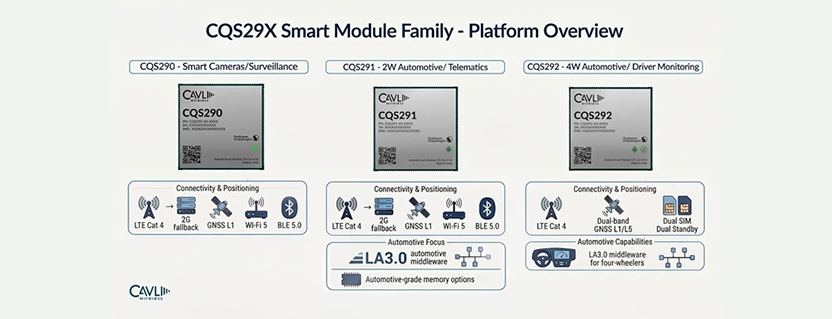
Cavli Wireless has introduced its CQS29X family of camera-focused IoT modules for applications including smart surveillance, automotive telematics, and driver monitoring. The family consists of the CQS290, CQS291, and CQS292, combining LTE Cat 4 connectivity, camera interfaces, edge processing, GNSS, and support for Linux or Android operating systems.
The CQS29X modules are designed around camera-based IoT applications and support multiple MIPI-CSI and MIPI-DSI camera interfaces. The modules provide dual ISP capabilities and support camera sensors with resolutions of up to 25 megapixels. Hardware-based image and video processing supports 1080p video encoding and decoding at 30 frames per second, with H.264 and H.265 support.
For surveillance applications, the modules can connect to two cameras through dual MIPI-CSI interfaces. The combination of camera inputs, local processing, and cellular connectivity allows the modules to handle video-related functions at the device level while providing a cellular backhaul connection.
The modules also provide interfaces for connecting peripherals used in surveillance equipment, including tamper sensors, audio devices, pan-tilt-zoom (PTZ) motors, and relays. The CQS29X family supports LTE Cat 4, with data rates of up to 150 Mbps for downloads and 50 Mbps for uploads. The modules also provide 2G fallback, allowing connectivity in networks where LTE coverage is unavailable. Wireless connectivity includes Wi-Fi 5 and Bluetooth 5.0, while GNSS support is available in configurations ranging from L1 to L1/L5. The modules also support an external SIM and Dual SIM Dual Standby (DSDS).

Alongside wireless connectivity, the modules provide a range of hardware interfaces, including SPI, UART, I2C, I3C, SD, ADC, and capacitive-touch interfaces. These interfaces allow the platform to connect with sensors, storage, control hardware, and other embedded peripherals.
The CQS29X family is intended for camera-based surveillance applications such as smart-city surveillance, campus security, and facility monitoring. A typical system can combine one or more cameras with local image processing, cellular connectivity, GNSS, and peripheral control interfaces within the same embedded platform.
The use of edge processing allows some camera and video operations to be performed locally rather than requiring all processing to be handled by a remote server. The modules’ cellular connectivity can then be used to transmit data or video to a remote monitoring system.
The CQS29X family also includes variants targeted at automotive applications. The CQS291 is positioned for two-wheeler applications, while the CQS292 is intended for four-wheeler applications.
The CQS292 supports an in-cabin driver monitoring system (DMS) camera connected directly through MIPI-CSI. Its processing platform includes a quad-core ARM Cortex-A53 processor and an Adreno 702 GPU, which can be used for processing camera frames in driver-monitoring applications.
These applications include monitoring for conditions such as driver drowsiness and distraction. The CQS292 also combines LTE Cat 4, 2G fallback, GNSS L1/L5, and LA3.0 automotive middleware for integration with connected-vehicle and telematics systems.
The CQS29X family incorporates LA3.0 automotive middleware for its two-wheeler and four-wheeler variants. This provides a software layer for automotive applications alongside the module’s processing, connectivity, and camera capabilities.
The three-module family allows the same general camera and connectivity architecture to be applied across different deployment scenarios, ranging from fixed surveillance equipment to two-wheeler telematics and in-cabin monitoring systems.
For equipment manufacturers, the CQS29X architecture brings camera interfaces, processing, video handling, cellular connectivity, GNSS, audio support, and peripheral interfaces together within a single IoT module. This approach can reduce the number of separate hardware components required in a camera-based system and simplify integration between the camera, processor, connectivity subsystem, and external peripherals.
The platform can therefore be used as the central computing and connectivity element in surveillance cameras, vehicle telematics equipment, driver-monitoring systems, and other camera-enabled IoT devices.
Overall, the CQS29X family combines LTE Cat 4 connectivity, edge processing, multi-camera support, GNSS, Wi-Fi, Bluetooth, and embedded interfaces in a module architecture aimed at camera-intensive IoT and automotive applications.
Click here to View the Original Article from Cavli Wireless.
Courtesy of Cavli Wireless