
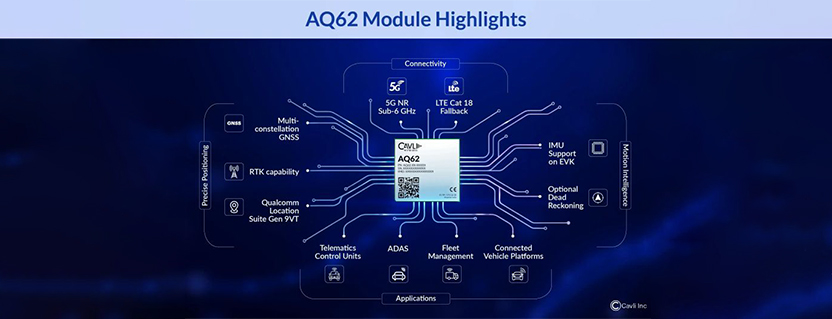
Modern connected vehicles require positioning capabilities that go beyond conventional GPS tracking. Automotive OEMs, Tier-1 suppliers, and mobility solution providers are developing increasingly intelligent vehicle platforms that depend on accurate, reliable, and continuous location intelligence.
Applications such as advanced telematics, fleet management, connected vehicle platforms, navigation systems, and ADAS require positioning systems that can perform across different operating environments. While traditional GNSS provides the foundation for vehicle positioning, GNSS-only positioning can face limitations in challenging scenarios such as dense urban environments, tunnels, underground parking areas, and locations with reduced satellite visibility.
To address these challenges, automotive positioning systems are increasingly adopting a multi-layer architecture that combines:
Beyond traditional GNSS-based positioning, AQ62 integrates multi-constellation GNSS support, its EVK offers an onboard IMU-based motion tracking, optional RTK and optional Qualcomm Dead Reckoning (QDR 3.0) to enable more accurate and continuous vehicle positioning.
With support for Qualcomm Location Suite Gen 9VT, AQ62 provides automotive OEMs and connected mobility developers with a foundation for building advanced vehicle positioning solutions.
By combining 5G NR connectivity, LTE Cat 18 fallback, edge computing capabilities, and advanced positioning technologies, AQ62 enables the development of intelligent connected vehicle platforms.
Vehicle tracking technology has evolved significantly. Earlier tracking systems primarily focused on identifying approximate vehicle location. Modern connected vehicles require more precise and context-aware location intelligence.
Today, vehicle positioning supports critical automotive functions, including:
For advanced automotive applications, accurate positioning enables real-time monitoring, optimized fleet operations, navigation services, connected vehicle experiences, and location-aware decision-making for systems such as ADAS.
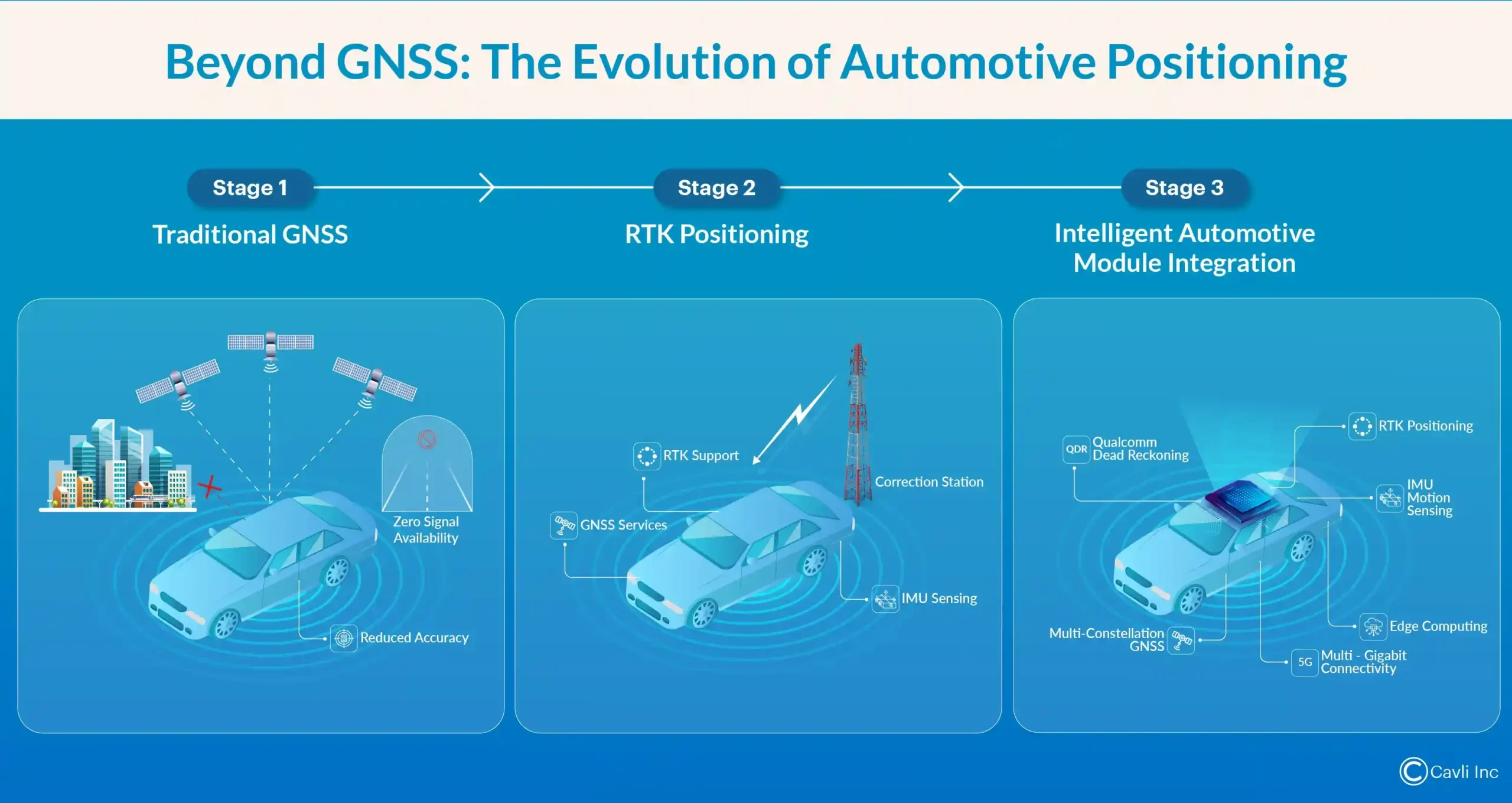
As automotive platforms move toward higher levels of intelligence, positioning is no longer only about determining where a vehicle is located. It is about enabling vehicles and connected services to interpret movement, context, and surroundings with greater precision.
GNSS as the Foundation of Automotive Positioning
Global Navigation Satellite Systems (GNSS) provide satellite-based positioning by calculating vehicle location using signals received from multiple navigation satellite constellations.
Modern automotive GNSS receivers can improve availability and reliability by supporting multiple satellite constellations.
AQ62 supports multi-constellation GNSS, including:
Supporting multiple satellite systems helps improve satellite availability and positioning reliability for global connected vehicle applications.
However, GNSS-only architectures may experience limitations when operating in environments where satellite signals are obstructed, degraded, or temporarily unavailable.
Common challenges include:
For this reason, advanced automotive positioning systems combine GNSS with additional technologies such as RTK, IMU-based motion sensing, and dead reckoning.
What Is RTK Positioning?
Real-Time Kinematic (RTK) is a GNSS enhancement technology that improves positioning accuracy by using correction data to refine standard GNSS calculations.
Traditional GNSS determines vehicle position using satellite signals. RTK improves this process by applying correction information, allowing positioning systems to achieve higher accuracy when suitable correction data is available.
For automotive applications, RTK positioning can support scenarios where improved location precision is required, including:
The Cavli AQ62 supports optional RTK capability for applications requiring enhanced positioning performance.
| Technology | Description | Automotive Application Consideration |
| Standard GNSS | Satellite-based positioning using navigation signals | Suitable for general vehicle tracking applications |
| RTK GNSS | Uses correction data to improve GNSS accuracy | Suitable for applications requiring higher positioning precision |
| GNSS + IMU | Combines satellite data with IMU-based motion sensing | Improves continuity during positioning challenges |
| GNSS + RTK + Dead Reckoning | Combines multiple positioning inputs | Supports advanced connected vehicle platforms |
RTK should be evaluated based on application requirements, correction-data availability, regional deployment conditions, and overall vehicle system architecture.
An Inertial Measurement Unit (IMU) provides additional information about vehicle movement by measuring parameters such as:
When combined with GNSS, IMU-based motion data provides additional context about vehicle movement and helps improve positioning continuity.
For automotive systems, this is important because vehicle movement information can continue contributing to positioning intelligence even when satellite positioning conditions become challenging.
AQ62 supports IMU integration as part of its advanced positioning architecture.
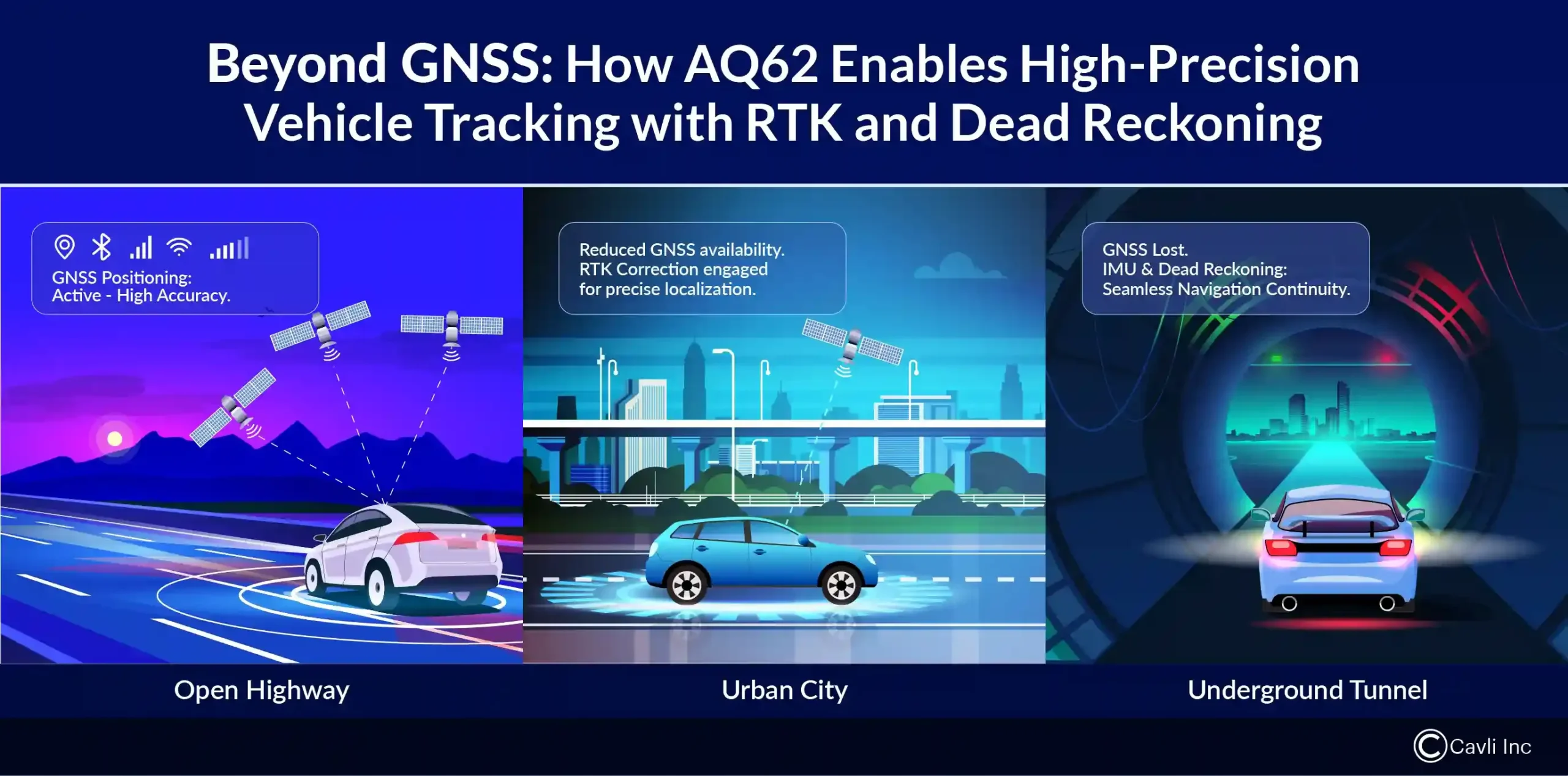
Dead reckoning helps estimate vehicle position when GNSS signals become degraded or unavailable.
By using movement information from sensors, dead reckoning enables systems to continue estimating vehicle location during temporary GNSS signal interruptions.
For connected vehicles, this capability is valuable because location services often need to remain functional across different driving environments.
AQ62 supports optional Qualcomm Dead Reckoning technology to improve location estimation continuity when GNSS availability is limited.
AQ62 brings together multiple positioning technologies to create a more robust automotive location architecture.
Instead of relying only on satellite signals, AQ62 combines GNSS information with motion data from IMU-based sensing to improve positioning reliability across different driving conditions.
For example, a connected vehicle operating in a dense urban environment may experience temporary GNSS signal degradation due to obstructions such as buildings blocking satellite visibility.
In such scenarios, combining GNSS information with vehicle movement data helps maintain better location awareness.
This multi-layer positioning architecture enables automotive OEMs to develop systems with improved:
AQ62 is designed to support automotive applications that require reliable and accurate location intelligence.
Modern vehicle platforms increasingly require positioning systems that can operate as part of a larger connected architecture. Instead of treating location as an isolated feature, automotive manufacturers need positioning capabilities that work together with connectivity, computing, and vehicle intelligence systems.
AQ62 supports advanced positioning capabilities through the integration of:
This combination allows automotive OEMs to develop platforms where location accuracy, availability, and reliability are considered core system capabilities rather than additional features.
Modern connected vehicles require multiple technologies to work together.
An automotive positioning system is no longer limited to a GNSS receiver. It must integrate:
AQ62 combines automotive-grade 5G connectivity, onboard processing, and advanced positioning capabilities into a single platform.
The module integrates:
By combining communication, computing, and positioning capabilities, AQ62 provides automotive OEMs with a foundation for developing future-ready connected vehicle platforms.
For automotive OEMs, developing reliable positioning systems traditionally requires integrating multiple components, validating different technologies, and ensuring that each subsystem performs effectively under real-world driving conditions.
A conventional GNSS-only architecture may provide accurate positioning in open environments, but performance can become challenging in areas with poor satellite visibility, including:
AQ62 addresses these challenges by combining GNSS with IMU-based motion sensing.
Instead of depending only on satellite signals, the module uses vehicle movement information to provide a more complete understanding of location and motion.
This creates a more robust positioning architecture compared with GNSS-only solutions.
For manufacturers developing advanced automotive solutions, optional RTK support and Qualcomm Dead Reckoning technology provide additional capabilities for applications requiring improved positioning accuracy and continuity.
Get in touch for orders or any queries: sales@rfdesign.co.za / +27 21 555 8400
Courtesy of Cavli Wireless