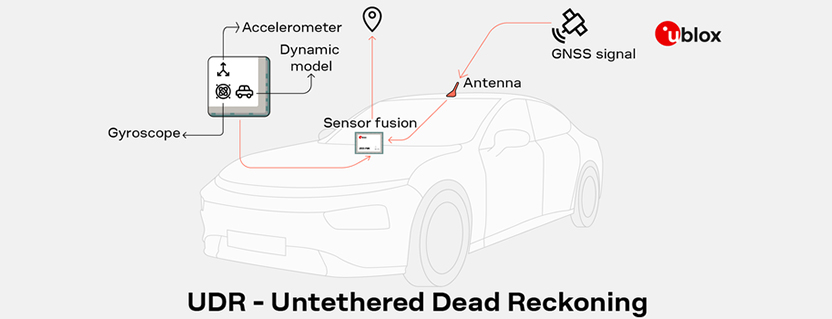
Vehicle tracking can lose continuity when satellite signals are obstructed by tunnels, multi-level parking structures or tall buildings. In these environments, a conventional GNSS receiver may produce intermittent fixes or degraded position estimates precisely when a navigation or fleet-management application needs a continuous route. Untethered Dead Reckoning (UDR) technology from u-blox addresses this problem by combining satellite positioning with inertial motion measurements, without requiring a direct electrical connection to the vehicle.
UDR uses GNSS observations together with accelerometer and gyroscope measurements from an inertial measurement unit (IMU). The system also applies a vehicle-motion model that accounts for physical constraints on normal vehicle movement, including the fact that a car does not ordinarily travel sideways. A Kalman filter combines these measurements and model assumptions to estimate position, velocity and heading as the vehicle moves through changing signal conditions.
During initial operation with usable satellite reception, the sensor-fusion process compares GNSS information with inertial measurements to estimate sensor biases, drift and alignment. Calibration is generally automatic and benefits from changes in speed and direction. When satellite reception becomes weak or disappears, the filter propagates the latest position estimate using the motion sensors and model, allowing the reported trajectory to continue through a tunnel or enclosed parking facility.
The approach does not eliminate inertial drift. Errors accumulate over time and distance when operation relies solely on dead reckoning, and the position estimate benefits from correction once reliable GNSS measurements return. Assisted GNSS can shorten the time needed to reacquire satellite information; the u-blox AssistNow service provides relevant assistance data, including orbit-related information for compatible workflows.
Conventional automotive dead reckoning may combine GNSS and inertial sensors with wheel-tick pulses or vehicle-bus speed signals. UDR avoids those direct vehicle-data connections, simplifying integration into retrofit telematics equipment and products installed across mixed vehicle fleets. The trade-off is that a solution with vehicle-sensor inputs can offer stronger position accuracy in some prolonged GNSS-denied conditions, particularly when precise standstill detection is important.
This installation model suits aftermarket navigation, fleet monitoring, car-sharing, long-term vehicle rental and road-tolling applications. u-blox connects UDR functionality to positioning hardware such as the NEO-M9V module and UBX-M9340 chip, with evaluation through the EVK-M9DR platform and u-center tooling. Used alongside appropriate GNSS assistance services, these devices provide developers with an integrated route from sensor-fusion evaluation to installed positioning systems.
Click here to learn more about u-blox Untethered Dead Reckoning.
Get in touch for orders or any queries: sales@rfdesign.co.za / +27 21 555 8400
Courtesy of u-blox
We use cookies to improve your experience on our site. By using our site, you consent to cookies.
Manage your cookie preferences below:
Essential cookies enable basic functions and are necessary for the proper function of the website.
Statistics cookies collect information anonymously. This information helps us understand how visitors use our website.
Google Analytics is a powerful tool that tracks and analyzes website traffic for informed marketing decisions.
Service URL: policies.google.com (opens in a new window)
Google reCAPTCHA helps protect websites from spam and abuse by verifying user interactions through challenges.
SourceBuster is used by WooCommerce for order attribution based on user source.