
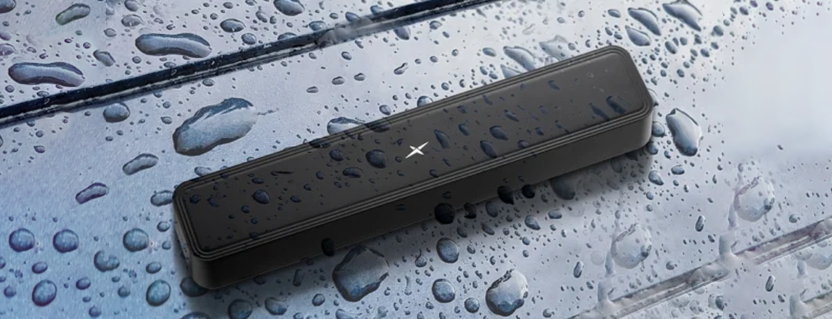
The world is a harsh place for wireless devices, especially their antennas, which get the brunt of the extremes. Engineers can’t predict everything that their devices will encounter in the real word, but focusing on five aspects goes a long way toward ensure that they’ll provide reliable performance under even the most unforgiving conditions.
Many applications require multiple antennas, such as one for GNSS and another for 4G/5G. The more antennas there are, the more it makes sense to combine them in a single enclosure for aesthetics, installation simplicity, and durability.
Case in point: The Taoglas Patriot series combines up to 18 antennas for 4G/5G, GNSS, LMR/TETRA, SDARS, and Wi-Fi in a single enclosure measuring just 205 mm long by 180 mm wide. Patriot is designed for first responder agencies and other fleet owners that want a single enclosure to avoid drilling a half dozen holes, which increase installation costs and create more ingress opportunities for water, dust, and insects. All of the antennas’ cables are routed through the Patriot’s 27 mm diameter threaded mounting stud and then spider out to their destinations around the vehicle.
When selecting an all-in-one system, pay close attention to the enclosure’s IP and IK ratings, which quantify its ability to protect the antenna elements inside from environmental damage. For instance, Patriot enclosures are rated IK08 and IP69K, which means they’re dust tight and can survive a 5 kg object dropped from 10 cm and jets of high-temperature water. In the real world, examples include hail, tree limbs, and power washers.


The highest possible rating also is one of the few with a letter following the two digits: IP69K, where the K indicates the ability to keep out water projected by high-pressure jets at temperatures up to 80 C. The K also indicates that the IP test procedure followed ISO20653, which is for automotive applications.
However, a device with a K rating may be used in non-vehicular applications where the antenna is subject to high-pressure hot water. For example, the Taoglas Raptor X MA8007 cellular/GNSS/Wi-Fi antenna is designed for applications such as first responder vehicles, which are power washed on a regular basis. But the Raptor also can be used in industrial IoT applications where pressure washers are routinely used to clean equipment, such as food production.
It’s important to note that not all IP ratings are alike. For example, IP67 is a fixed rating, which means that every device with that label can withstand up to 1 meter submersion for 30 minutes. By comparison, IP68 is not a fixed rating. Instead, it’s based on each customer’s unique requirements.
For instance, the Samsung Galaxy S24 Ultra and iPhone 16 both have an IP68 rating. But the S24 is designed to withstand submersion in up to 1.5 meters of water for up to 30 minutes, while the 16 is designed for up to 6 meters for 30 minutes. So when comparing enclosures that have IP68 ratings, dig deeper to find out exactly how each manufacturer arrived at that rating and whether that applies to your use case. (For more information, see “How IP and IK Ratings Measure Real-World Durability” and “What Does an IP67 Rating Really Tell You about an Antenna’s Durability?”)
Finally, some applications use whips, such as LMR/TETRA. Although those antennas aren’t protected by an enclosure, IP ratings are still a critical spec to scrutinize. For example, the Taoglas FW.15 whip is clad in thermoplastic polyurethane (TPU), a flexible yet durable material that’s ideal for demanding marine and industrial environments. That’s why the FW.15 has an IP67 rating and an operating temperature range of -40°C to 85°C.
The Taoglas website makes it easy to browse antennas by IP rating. Visit https://www.taoglas.com/product-category/external-antennas and then select a rating to see all available models. Taoglas offers over 200 external antennas with an IP67 rating.
Marine and aerospace are two examples of unique environments that in turn require unique enclosures to withstand extreme conditions. But the design strategies used there are applicable to other applications. For instance, a telematics device for intermodal shipping containers benefits from marine-grade durability for tracking the location and status of high-value cargo during the ocean leg of its journey.
One solid choice is the Taoglas Neptune XAHP.30, which has an IP67 enclosure that’s designed to withstand salt spray, thus protecting the GNSS antenna elements from corrosion. The Neptune’s enclosure also is domed, which prevents bird damage by making it uncomfortable to perch. That’s critical for PNT accuracy because a bird’s body can severely attenuate GNSS signals.
Another example is drones used for civilian enterprise applications that can leverage defense-grade antennas because they help ensure mission-critical PNT and connectivity. When comparing antennas, scrutinize each manufacturer’s mechanical engineering expertise in areas such as:
For more insights, see:
All GNSS signals are relatively weak by the time they reach the Earth, and physical obstructions such as foliage and high rises can further attenuate them to the point that they’re unusable. One solution is to equip the device with a module and antenna that support multiple GNSS constellations.
For example, the Taoglas Accura, Pantheon and Bolt support multiple combinations of Galileo, GLONASS, and GPS. If one constellation’s signals are too weak or unavailable, the second or third alternate constellation may be viable because they use different frequencies. (For more insights, see “GNSS vs. GPS: What’s the Difference?” and “GNSS Constellations: Exploring GPS, GLONASS, Galileo, BeiDou, NavIC, and QZSS.”)
A multi-band design strategy is equally effective with cellular. Wideband antennas such as the Taoglas Pantheon MA750 (600 MHz to 6 GHz) and the Taoglas TGX.45.A (400 MHz to 6 GHz) support every LTE band and every 5G allocation up to the mid-band spectrum range. That coverage means the device now has the flexibility to switch bands or even operators to establish and maintain a reliable connection.
Even the best antenna can’t get a cellular signal if there aren’t any to begin with, such as rural and remote places where the pool of potential customers is too small to support even one cell site. A new solution is Non-Terrestrial Networks (NTNs), which use LEO, MEO, or GEO satellite constellations such as Amazon/Kuiper, OneWeb, Skylo, and SpaceX/Starlink. Satellite fallback isn’t new, but today’s NTNs dramatically lower the cost to the point that it’s viable for more applications than ever. Many LEO and 5G bands are close enough that a single antenna can cover both. That’s why modules that support both cellular and NTN have a single RF connector for the antenna. (To learn more, see “The Sky is the Limit: Combining Cellular, GNSS, and NTN for Seamless Global Connectivity, Positioning, and More.”)
MIMO is a powerful way to maximize application performance and reliability in 4G, 5G, and Wi-Fi. But that power comes with responsibility of ensuring that all of those antennas don’t interfere with one another when transmitting. On the receive side, the MIMO system must be coordinated to ensure that the antennas are working together to maximize reception from multiple directions.
Spatial diversity helps achieve isolation in MIMO systems. The diversity antenna should be oriented in a way that’s significantly different from the primary transmit/receive antenna’s position. An example is placing the diversity antenna at the top of a device and the primary antenna at the bottom, with a 90-degree difference in orientation. This achieves both spatial diversity and spatial separation. (For a deeper dive, see “Understanding Antenna Spatial Diversity and How It Affects Device Performance.”)
Every design should be thoroughly tested in real-world environments to verify performance and make final adjustments before the product ships (in the case of GNSS) or is submitted for carrier certification (cellular only or cellular with additional technologies, such as GNSS or Wi-Fi). This step requires the kind of extensive experience and specialized equipment that few device OEMs and systems integrators have in house.
That’s why those companies frequently turn to Taoglas, which has spent nearly a quarter century helping develop and refine hundreds of different types of devices for cellular, GNSS, Wi-Fi, and other technologies. Taoglas’ engineering services are a convenient way to leverage that expertise to keep projects on time and on budget.
One example is GSA.40 which quantifies a GNSS device’s performance in open-sky scenarios using known references. If the results don’t meet application requirements, Taoglas can recommend options for optimizing performance. Specialized testing in urban canyon environments is available.
Get in touch for orders or any queries: sales@rfdesign.co.za / +27 21 555 8400
Courtesy of Taoglas