
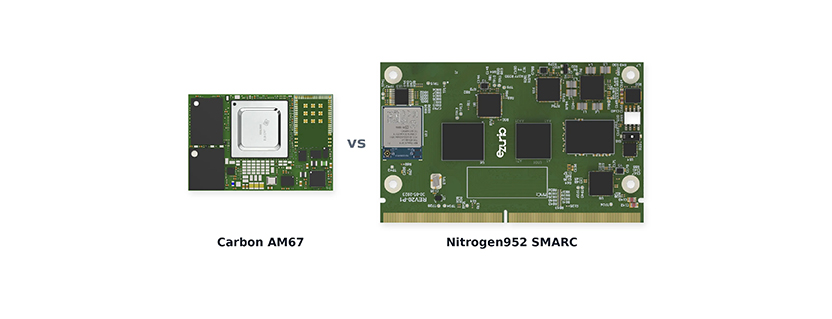
Two strong platforms with different strengths. The Carbon AM67 OSM-MF and the Nitrogen952 SMARC both target industrial HMI, medical devices, smart appliances, and vision systems, but they approach the problem from different angles. The AM67 is TI silicon on a compact solder-down module with a vision pipeline. The i.MX 952 is NXP silicon on a SMARC module with functional safety and a strong security architecture. The right silicon depends on what the product actually needs to do.
The Carbon AM67 is the stronger choice for vision-heavy, multi-camera, and triple-display designs. The Nitrogen952 is the stronger choice for designs that need functional safety certification, the latest NXP security architecture, or the flexibility of a SMARC module.
Before comparing specs, it’s worth addressing the form factor question directly because it shapes every other decision. The Carbon AM67 uses the OSM-MF v1.2 standard: 45×30mm, solder-down, permanent. The Nitrogen952 uses SMARC 2.2: 82×50mm, edge connector.
This isn’t about one being better. It’s about what suits the design. OSM makes sense when wanting the smallest possible board footprint and not needing to swap modules in the field. SMARC makes sense when wanting to develop and potentially upgrade to a different processor without a carrier board respin. The SMARC 2.2 standard means a carrier designed for the Nitrogen8M Plus or Nitrogen937 is compatible with the Nitrogen952.
Ezurio will have an i.MX 952 OSM-MF module coming, so if committed to the OSM form factor and wanting NXP silicon, that path will exist. For now, if OSM is needed today, the Carbon AM67 is it.
The AM67 is the stronger platform when:

The Nitrogen952 is the stronger platform when:

| Category | Specification | Carbon AM67 OSM-MF | Nitrogen952 SMARC | What It Means |
|---|---|---|---|---|
| Processing | Processor | TI AM67A / AM675 4x Cortex-A53 @ 1.4 GHz |
NXP i.MX 952 4x Cortex-A55 @ 1.7 GHz |
The A55 has better IPC. The AM67A has more accelerators. |
| AI / ML | 2x C7x DSP/DL 4 TOPS |
eIQ Neutron NPU 2 eTOPS |
Different architectures. Don’t compare TOPS directly. | |
| Multimedia | Camera / Vision | 4x MIPI-CSI-2 (4-lane) 600 MP/s ISP |
1x MIPI-CSI 500 MP/s ISP w/ RGB-IR |
AM67 is built for multi-camera vision. |
| Display | MIPI-DSI + 2x LVDS Up to 3 simultaneous |
MIPI-DSI + 2x LVDS Up to 2 simultaneous |
Three panels requires the AM67. | |
| Safety & Security | Functional Safety | None | ASIL-B / SIL-2 capable | Only the 952 has a path to IEC 61508 or ISO 26262. |
| Security | TI HSM, secure boot ARM TrustZone |
EdgeLock Secure Enclave PQC boot |
PQC boot fits EU CRA and medical requirements. | |
| I/O & Memory | USB | 1x USB 3.1 Gen1 1x USB 2.0 |
2x USB 2.0 | AM67 is the only option for USB 3.0. |
| PCIe | 1x PCIe Gen3 x1 | 1x PCIe Gen3 x1 (muxed with 2.5 GbE) |
On the 952, pick PCIe or 2.5 GbE at design time. | |
| Memory | 4GB or 8GB LPDDR4 | Up to 8GB LPDDR4X / LPDDR5 | The 952 adds LPDDR5 bandwidth. | |
| Platform | Form Factor | OSM-MF v1.2 45 × 30 mm, solder-down |
SMARC 2.2 82 × 50 mm, socketed |
OSM is smaller and permanent. SMARC is easier to swap. |
A few patterns come up when customers are choosing between these two platforms.
Vision-focused designs go AM67: Industrial inspection, navigation systems, multi-camera kiosks, and medical imaging devices that need to process feeds from more than one camera are a great fit for the Carbon AM67’s vision pipeline. The combination of four MIPI-CSI interfaces and the dedicated optical flow accelerator is built for this. Trying to replicate that in software on the i.MX 952 adds CPU overhead and cost.
Safety-certified designs go 952: Any product going through a formal functional safety certification process—like medical class II/III devices, industrial machinery under IEC 62443, or safety-rated HMI panels—needs hardware that supports a safety case. The AM67 doesn’t have that path. The i.MX 952 does.
General HMI and smart appliance designs can go either way: For a single-display or dual-display touchscreen product without specific vision requirements or safety certification needs, both platforms are capable. Form factor preference, ecosystem familiarity, and board layout tend to be the deciding factors.
Ezurio built both products because one platform doesn’t win everywhere. The Carbon AM67 OSM-MF comes with evaluation kits to test your product. The Nitrogen952 SMARC will have availability for customers working on designs that need it. Contact Ezurio when planning ahead on an i.MX 952-based product.
Both modules carry Ezurio’s standard approach: optional integrated Wi-Fi 6/6E and Bluetooth, industrial temperature options, BSP support across Yocto, Buildroot, Android, and QNX, and worldwide regulatory certifications. The form factors are different—OSM-MF for solder-down production designs, SMARC 2.2 for upgradeable platforms—but the support model is the same.
Beyond hardware, Ezurio provides application engineering support to help products ship: BSP bring-up assistance, carrier board design reviews, RF and antenna guidance, and regulatory certifications including FCC, IC, CE, UKCA, RCM, MIC, KC, and Bluetooth SIG. US-based manufacturing is available for customers with domestic supply chain requirements, along with global capacity through Ezurio’s footprint for EMEA and APAC.
If the product has more than one camera, needs USB 3.0, drives three displays, or has to fit on a tight board, select the Carbon AM67. If the product needs safety certification, the NXP security architecture for compliance, or the long-term upgrade flexibility of SMARC 2.2, then select the Nitrogen952.
If neither of those is a clear differentiator for the application, speak to Ezurio’s applications engineering team. Ezurio will review specific requirements and provide an objective recommendation on which platform makes sense or whether a different option is a better fit altogether.
To evaluate the Carbon AM67 OSM-MF, visit www.ezurio.com/carbon-am67 to learn more.
To find out more about the Nitrogen952 SMARC, visit www.ezurio.com/nitrogen952-smarc.
Contact the Ezurio engineering team or visit ezurio.com for datasheets, evaluation kits, and design support.
Get in touch for orders or any queries: sales@rfdesign.co.za / +27 21 555 8400
Courtesy of Ezurio