
Overcoming 5G NR-based IoT Design Challenges with Cavli’s Dual Form Factor CQM211
OEM teams building high-throughput 5G IoT products often face the same engineering bottleneck: you can either optimize the hardware deeply for your end application, or you can move fast enough to meet aggressive roadmaps, but doing both usually means repeated PCB spins, interface compromises, and painful upgrade paths.
Three challenges show up repeatedly in product engineering cycles:
- Designing for 5G throughput without turning the module into a hinge that constrains the rest of the system architecture.
- Balancing customization vs time-to-market, especially when multiple SKUs or regional variants are involved.
- Managing upgrade paths from LTE/transitional designs to full 5G NR, without rewriting your hardware strategy every cycle.
Cavli has built the CQM211 specifically to resolve this tension: deliver a 5G platform that’s compute-capable and interface-rich, while offering form-factor flexibility that supports both ground-up designs and fast migrations.
Introducing Cavli CQM211: Entry-Level 5G NR Connectivity Without Trade-Offs
Cavli’s CQM211 is a 5G NR/LTE Cat 16 cellular IoT module designed as a high-throughput IoT connectivity and compute platform, not just a connectivity add-on. At its core is the Qualcomm SDX61 chipset, designed to enable modern 5G product architectures where the modem is only one part of the story.
Under the Hood:
- Compute: Pairs connectivity with an Arm Cortex-A7 CPU (up to 1.8 GHz) and a Hexagon DSP (up to 1.5 GHz Turbo).
- OS & SDK: Runs OpenWrt OS with extensive SDK support, providing a familiar Linux environment for networking stacks and security tooling.
- Memory: 1GB LPDDR4X and 4GB NAND, sized for logs, certificates, containers, and update frameworks.
- Connectivity: Supports 3x carrier aggregation for sustained data rates.
- Antenna & GNSS: Features 5 antennas total (4 RF + 1 GNSS) and in-built, dual-band GNSS covering GPS, GLONASS, Galileo, BeiDou, QZSS, SBAS, and NavIC.
The EDGE Advantage: Dual Form Factor Strategy
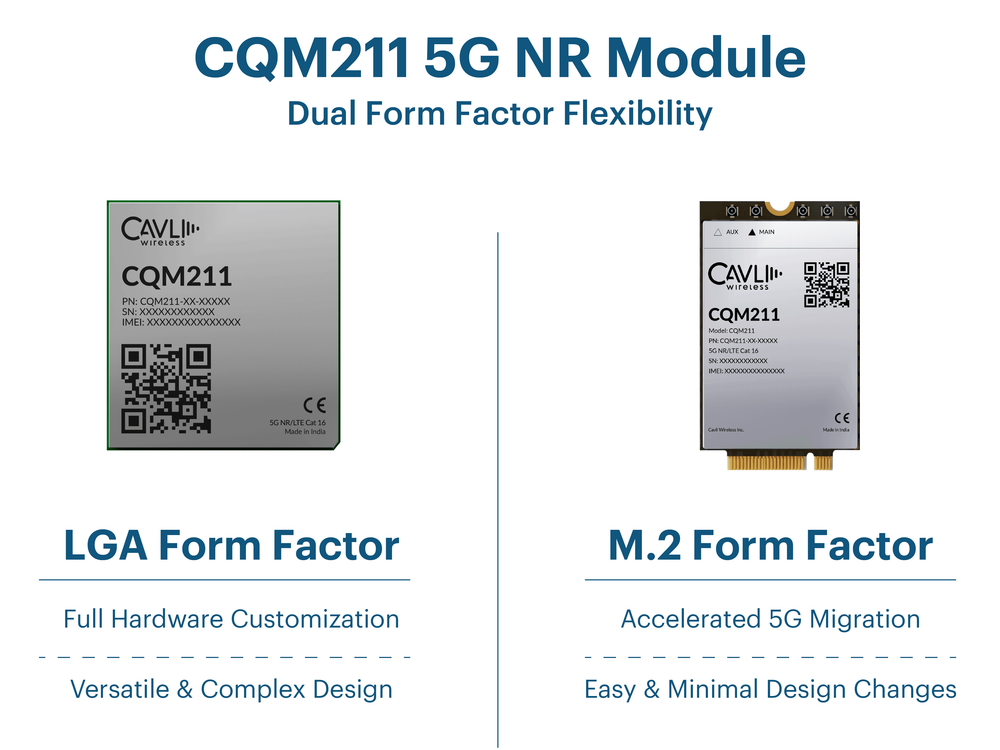
The CQM211 is available in two form factors: LGA and M.2.
- LGA: For teams designing fully customized hardware with deep integration and maximum interface reach.
- M.2: For teams migrating existing LTE/RedCap-style modular designs toward 5G NR with minimal disruption.
Engineering Implications for OEMs
LGA Variant: Full Hardware Customization Targets OEMs building throughput-intensive devices from scratch where the PCB and peripheral selection are central to differentiation.
- Interfaces: Includes COEX UART, 2x USIM, UART, HS USB 2.0/SS USB 3.1, I2C, 2x I2S, 2x SPI, PCIe Gen3 (2-lane), 1 SDC, 16 configurable GPIO, and 8-bit/9-bit LCD via EBI2.
- Use Case: An enterprise-grade CPE router can use the LGA variant to add PCIe-connected expansion, integrate additional storage, or implement custom displays.
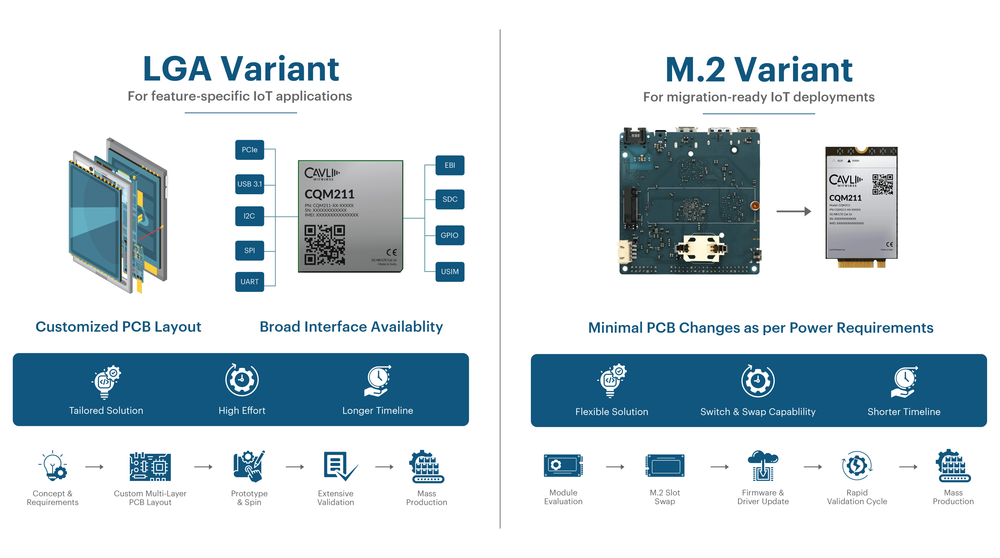
M.2 Variant: Accelerated 5G Migration Preserves validated system architecture for teams that do not have the luxury of a ground-up redesign.
- Interfaces: Clean interface set including HS USB 2.0/SS USB 3.1, PCIe Gen3 (2-lane), I2S, 2x USIM, COEX UART, and I2C.
- Benefits: Offers a drop-in migration pathway, reduced PCB redesign, shortened validation cycles, and faster certification continuity.
Practical Implications for End Users
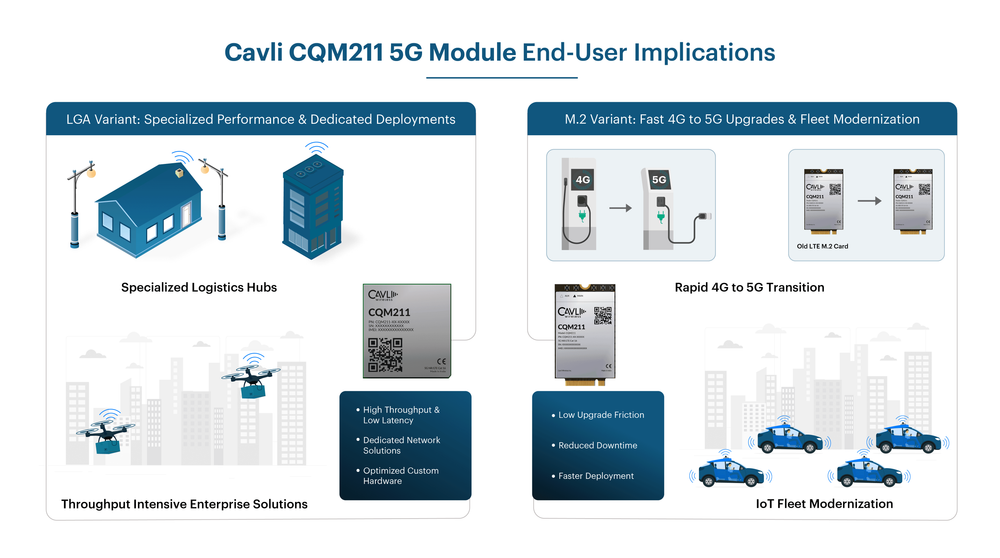
- LGA-based products: Result in highly specialized solutions for logistics hubs or manufacturing floors with optimized performance and reduced integration compromises.
- M.2-based products: Enable rapid 4G-to-5G transition and faster fleet modernization with lower upgrade friction and less downtime.
Closing Notes: One 5G Platform, Two Integration Speeds
Whether you are building a differentiated enterprise FWA/CPE system from the ground up or upgrading an installed base of industrial gateways, CQM211 is designed to be the 5G core you can standardize on.
Get in touch for orders or any queries: sales@rfdesign.co.za / +27 21 555 8400
Courtesy of Cavli Wireless Inc.
