
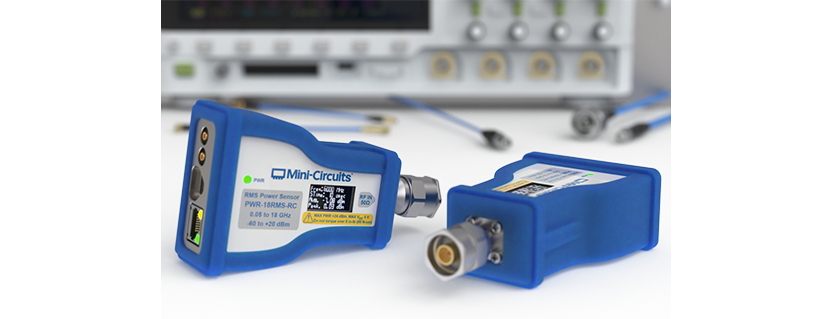
Finding the Right RF Power Sensor for Your Application
A reliable power sensor is is essential for precise signal power measurement in RF and microwave applications. Whether it’s a USB RF power sensor, peak power sensor, or any other type, these devices provide the data needed to ensure your systems perform optimally. Power sensors are integral to fields ranging from advanced telecommunications to aerospace systems, medical devices, and many other industries.
Finding a suitable power sensor can be time-consuming due to the many options available and specifications to consider. Understanding each type’s key features and capabilities can help you quickly identify and purchase the power sensor that best suits your use case, allowing you to focus on your project’s success without unnecessary delays. This blog will cover everything you need to know about power sensors and their appropriate applications. It’s a long read, so feel free to use the jump links below to access any section that matters most to you! Or, if you’re ready to discuss your next power sensor purchase with Mini-Circuits, click here.
- The Role of Frequency Range in Power Sensors
- What is a Power Sensor’s Dynamic Range
- Understanding Peak and Average Power Sensor Measurements
- Understanding Root Mean Square or RMS Power Sensor Measurements
- Use Cases for Continuous Wave (CW) Power Measurement
- Choosing Between Mid-Tier and Upmarket Sensors
- Power Sensor Software Support
- Choosing the Right Power Sensor at a Glance
The Role of Frequency Range in Power Sensors
The frequency range of a power sensor determines the types of signals it can measure. Mini-Circuits offers power sensors with frequency ranges from 9 kHz to 40 GHz, covering a broad spectrum of applications. Lower frequencies are often used in audio and sub-GHz communication, while higher frequencies are needed for microwave and millimeter-wave applications.
Lower frequencies work well for AM/FM radio broadcasting in the telecommunications industry, while higher frequencies are critical for satellite communications and 5G technology. In the medical field, lower frequencies could be used for diagnostic ultrasound, whereas higher frequencies are necessary for advanced imaging techniques like MRI. A broad frequency range ensures that one sensor can be used for multiple applications, providing flexibility and cost savings.
For example, a 40 GHz power sensor can be used for both traditional RF measurements and emerging 5G technologies, making it a versatile tool in both current and future applications. Sensors with lower frequency ranges are cost-efficient and well-suited for basic RF applications.
What Is a Power Sensor’s Dynamic Range?
Dynamic range is the span between the smallest and largest signals a sensor can accurately measure. Mini-Circuits’ power sensors offer dynamic ranges from -60 to +20 dBm, ensuring precision across a wide range of signal strengths. Precision and range are essential for applications where signal strength varies significantly, such as in communication systems where signals fluctuate due to environmental factors.
A sensor with a wide dynamic range can handle weak signals without being overwhelmed by stronger ones, making it versatile and reliable for complex measurement tasks. For instance, in a satellite communication system, a power sensor must measure both the faint signals from distant satellites and the strong signals from ground stations. Similarly, signal strength can vary in wireless communication networks due to obstacles, distance, and interference, requiring a sensor that can accurately measure a wide range of signal levels.
Consider an RF testing scenario where an engineer must measure signals from low-power IoT devices and high-power communication transmitters. A power sensor with a limited dynamic range might only be able to measure one of these effectively, but a power sensor with a wide dynamic range can handle both, providing more comprehensive and accurate data.
Additionally, dynamic range is vital in electromagnetic compatibility (EMC) testing. EMC testing often involves measuring low-level emissions from electronic devices and higher-level interference signals. A power sensor with a broad dynamic range can accurately capture this wide spectrum of signal strengths, ensuring devices meet regulatory standards and perform reliably in real-world environments.
In radar systems, dynamic range is critical for detecting targets at varying distances and with different reflective properties. A radar system must measure weak reflections from distant targets and strong signals from nearby objects. A power sensor with a wide dynamic range allows for accurate measurement and differentiation of these signals, enhancing the radar system’s effectiveness and reliability.
Understanding Peak and Average Power Sensor Measurements
Power sensors typically measure peak and average power, which are important for different reasons. Peak power measurement captures the highest power level in a signal, which is essential for applications like radar and pulsed communication systems, where peak values determine system performance.
Peak power measurement is crucial for applications that rely on short, high-intensity bursts of energy. In radar systems, for example, peak power determines the maximum range and resolution of the radar. High peak power lets the radar detect objects at greater distances and with finer detail. Similarly, in pulsed communication systems, peak power can influence the quality and integrity of the transmitted signal, affecting overall system performance.
On the other hand, average power measurement provides a mean value over time, which is helpful for continuous wave (CW) signals and modulated signals in communication systems. CW signals, which maintain a constant amplitude, are often used in applications like RF heating and continuous signal transmission. In these cases, average power measurement is critical for ensuring consistent performance and avoiding signal degradation.
In wireless communication systems, measuring peak and average power is essential for optimizing performance and ensuring regulatory compliance. For example, regulatory bodies often set limits on the peak and average power levels of transmitted signals to minimize interference and ensure safe operation. Mini-Circuits’ power sensors are equipped to measure peak and average power, offering comprehensive analysis capabilities.
Measuring peak and average power is valuable in testing and developing RF components and systems. Engineers can use these measurements to characterize the performance of amplifiers, transmitters, and other RF devices, ensuring they meet design specifications and operate reliably under various conditions. For instance, engineers might use peak power measurements to evaluate the amplifier’s ability to handle high-intensity signals without distortion when developing a new RF amplifier. In contrast, average power measurements would help assess its performance under normal operating conditions.
Moreover, accurate peak and average power measurement is essential for patient safety and effective treatment in medical applications such as MRI and RF ablation. In MRI systems, peak power measurements ensure the system can generate strong enough magnetic fields for high-resolution imaging. In contrast, average power measurements help monitor and control the overall energy exposure to the patient. Similarly, in RF ablation, precise control of power levels is crucial for effectively targeting and treating tissue without damaging surrounding areas.
Mini-Circuits’ peak and average power sensors offer precise and reliable measurements, ensuring your projects meet performance and regulatory standards. Our power sensors’ dual capability in measuring peak and average power ensures that engineers and technicians have the comprehensive data to optimize system performance and ensure compliance with industry standards.
Understanding Root Mean Square or RMS Power Sensor Measurements
RMS power measurement is another critical feature of power sensors. It provides the effective power value of a varying signal. It is particularly useful for complex modulated signals with varying power levels. Mini-Circuits’ sensors offer true RMS measurements, ensuring an accurate representation of signal power regardless of modulation type.
RMS power measurement calculates the square root of the average squares of the signal’s instantaneous values. This method gives a more accurate measure of the power content in signals that fluctuate in amplitude, making it essential for evaluating complex waveforms.
In audio applications, RMS power measurement provides a more accurate representation of the perceived loudness of a sound signal compared to peak or average power measurements. For instance, when designing and testing audio equipment such as amplifiers and speakers, RMS measurements ensure consistent performance across different signal types, delivering a better listening experience.
In wireless communication systems, RMS power measurement helps assess the overall power of modulated signals, such as those used in Wi-Fi and LTE networks. Accurate RMS measurements are crucial for optimizing signal quality and ensuring compliance with regulatory standards. For example, a wireless communication device might transmit varying amplitudes due to modulation schemes like QAM or OFDM. RMS power measurements help evaluate the actual power getting transmitted, ensure efficient spectrum use, and minimize interference with other devices.
RMS power measurement also plays a role in medical applications like MRI and RF ablation. In MRI systems, accurate RMS measurements ensure that the magnetic fields generated are within safe and effective levels for high-quality imaging. In RF ablation, precise RMS power control is necessary for targeting and treating tissue without causing unintended damage to surrounding areas.
In industrial and scientific research, RMS power measurement evaluates the performance of various RF and microwave components, such as amplifiers, oscillators, and filters. For example, researchers developing a new RF amplifier need to understand how the device handles different signal types and power levels. RMS measurements provide insights into the amplifier’s efficiency and linearity, essential for ensuring reliable and high-performance operation.
Mini-Circuits’ true RMS power sensors deliver the accuracy and reliability needed for these demanding applications, making them a trusted choice for engineers and technicians. Their capability to provide precise RMS measurements, regardless of the modulation type, ensures that users can rely on consistent and accurate power readings for their critical projects.
Use Cases for Continuous Wave (CW) Power Measurement
True to its name, Continuous Wave (CW) power measurement captures the power of a continuous, unmodulated signal. This type of measurement is essential for basic RF testing and calibration. Mini-Circuits’ sensors excel in CW power measurement, providing stable and accurate results for consistent signals.
CW measurements are particularly useful in applications like RF heating, where a stable power output is critical for maintaining consistent heating levels. For example, in industrial processes that require precise temperature control, such as plastic welding or material processing, maintaining a consistent power level ensures uniform heating and high-quality results.
Similarly, CW measurements ensure that amplifiers deliver the expected power levels in RF amplification, providing reliability and performance. In communication systems, amplifiers must operate at specified power levels to maintain signal integrity and prevent distortion. CW power measurements allow engineers to verify and calibrate amplifiers to meet these requirements, contributing to the overall reliability of the communication system.
In scientific research, CW measurements study the behavior of materials and components under steady-state conditions. Researchers might use CW power to investigate materials’ thermal properties or test the long-term stability of electronic components. Accurate CW power measurements enable precise control and repeatability in these experiments, leading to more reliable and meaningful results.
Additionally, CW power measurements support developing and testing RF and microwave components, such as filters, oscillators, and mixers. These components must operate correctly under continuous signal conditions, and CW measurements provide the necessary data to ensure their performance meets design specifications.
Power Sensor Software Support
Mini-Circuits’ power sensors come with robust software support. We offer USB RF power sensors and Ethernet power sensors for easy integration into automated test systems and remote operation. The software provides comprehensive data analysis and visualization tools, enhancing the sensors’ usability and functionality.
Our software’s capability to handle high sample rates, up to 80 million samples per second, ensures detailed and accurate signal analysis. This is particularly useful in applications like RF signal monitoring, where capturing fast signal variations is essential for precise analysis and troubleshooting.
Choosing the Right Power Sensor at a Glance
When choosing a power sensor, consider the following factors:
- Frequency Range: Ensure the sensor covers the necessary frequency range for your application.
- Dynamic Range: Choose a sensor with a dynamic range that matches the expected signal strengths.
- Measurement Types: Determine if you need peak, average, RMS, or CW measurements, and select a sensor that supports these.
- Connectivity: Consider the connectivity options (USB, Ethernet) and ensure they fit your test setup.
- Software Support: Look for sensors with robust software capabilities for data analysis and visualization.
Ready to find the perfect Power Sensor for your needs?
Courtesy of Mini-Circuits
