

[vc_row][vc_column][vc_column_text css=””]
Introducing NORA-B27 – a new, cost-optimized variant in the NORA-B2 module family powered by u-connectXpress.
You’ve probably been there: a prototype on your desk, a deadline looming, and a sinking feeling that your wireless stack might sink the schedule. It’s the age-old story of great ideas outpacing available hours. Decades ago, we wrestled with tangles of cassette player cords; today it’s firmware tangles and certification hoops. AT commands, first conceived in the 1980s to simplify modem control, have evolved to help tame this complexity. And Bluetooth Low Energy (LE) – with its low power use and efficient design for IoT devices – has become a key enabler of modern wireless connectivity. Progress isn’t always linear, but sometimes it circles back with a cleaner path forward.
In short-range wireless, that cleaner path is u-connectXpress – our proven AT-command software that handles the Bluetooth LE details behind the scenes. And with NORA-B27 joining the NORA-B2 series, you get a cost-optimized Bluetooth LE module that keeps the same simple developer experience as you scale. Think of it as the everyday tool that does exactly what you need – with a polish you only notice when it’s not there.
Both u-connectXpress and NORA-B2 series are part of our broader portfolio of IoT solutions, designed to address wireless connectivity challenges across many applications and use cases.
Short-range radios have come a long way – Bluetooth is standardized, smartphone-friendly, everywhere. But the to-do list behind any “Bluetooth-enabled” product still reads the same: integrate the protocol stack, harden security, hit power budgets, pass regulatory certification – then do it all again for the next product variant. These challenges are universal in the industry. No matter how the technology evolves (for example, Bluetooth Core 6.0 introduced distance-aware features like Channel Sounding), the core pressure remains: ship a product that’s reliable and fast, without blowing the schedule or budget. A key difference in modern IoT system design is balancing low power consumption with maintaining high performance – achieving energy efficiency does not have to come at the expense of device capability. The ability to maintain this balance is especially critical in scenarios where battery replacement is challenging or costly.
Much of that pressure comes from Bluetooth LE’s inherent complexity. A Bluetooth LE device’s wireless link is governed by a multi-layer protocol stack (from the physical radio layer up to the GATT data framework), with devices taking on roles like Central or Peripheral and Client or Server to manage data exchanges. Controlling the different operational modes of the device is essential to optimize power consumption and extend battery life. Each layer and role is powerful but adds intricacy – from negotiating connections and maintaining ultra-low power states, where selecting the appropriate modes is crucial for maximizing battery longevity, to handling GATT services and characteristics. Traditionally, developers have to wade through all these details to ensure reliable, low-latency communication and optimized power usage. It’s a lot of moving parts to coordinate. And yet, the prime directive never changes: deliver a dependable product to market, fast.
This is where u-connectXpress comes in. As a key component of our short-range portfolio, u-connectXpress provides a clean, streamlined AT command interface across our supported modules. You simply power on the module, send familiar text commands over UART or USB, and let the module’s firmware handle all the Bluetooth LE heavy lifting behind the scenes. In other words, u-connectXpress compresses the entire Bluetooth LE protocol complexity into a set of clear, high-level commands you can read at a glance – no deep dives into the Bluetooth stack required.
Importantly, the u-connectXpress firmware comes pre-flashed on the module, with secure boot and built-in update mechanisms. That means you start prototyping on day one, and you can keep your deployed devices up-to-date securely down the road. Put simply, you configure and connect devices by sending human-readable commands, and the module’s onboard software does the rest.
Because u-connectXpress speaks the universal language of AT commands, it’s immediately familiar to any developer who has used modem-style commands. AT commands are widely used across many wireless products – not just Bluetooth, but also Wi-Fi™, cellular, etc. – making them a versatile and time-tested way to configure devices. Developers can use for example AT commands to query and configure device details, connection parameters, and GATT services for Bluetooth LE communication. That uniformity pays off twice: it reduces effort now and keeps your designs portable for the future. When standards evolve or you upgrade hardware, you’re not rewriting your application from scratch – you’re still issuing the same class of commands to a known API. This consistency in the interface means you can swap modules or even transition between wireless technologies with minimal changes to your host code, preserving your development investment.
Example: Cable replacement in three AT commands – Curious how easy it is to use u-connectXpress? For example, imagine replacing a serial cable with a Bluetooth LE link between two devices – a classic use case. With u-connectXpress, it can take just three quick AT commands.
Assuming the remote device is connectable and configured, here is the code:

Once the Bluetooth LE link is established, the system can transmit and receive data between the devices, enabling seamless bidirectional communication.
The module provides simple output like “OK” or error codes for each command, so you know immediately if it succeeded. In short, u-connectXpress turns a daunting integration into a plug-and-play experience.
There are many more AT command examples and use cases in our documentation and GitHub for when you’re ready to dig deeper. But even at a glance, the approach is clear: no custom Bluetooth code, no learning low-level Bluetooth LE APIs – just configure, connect, and go.
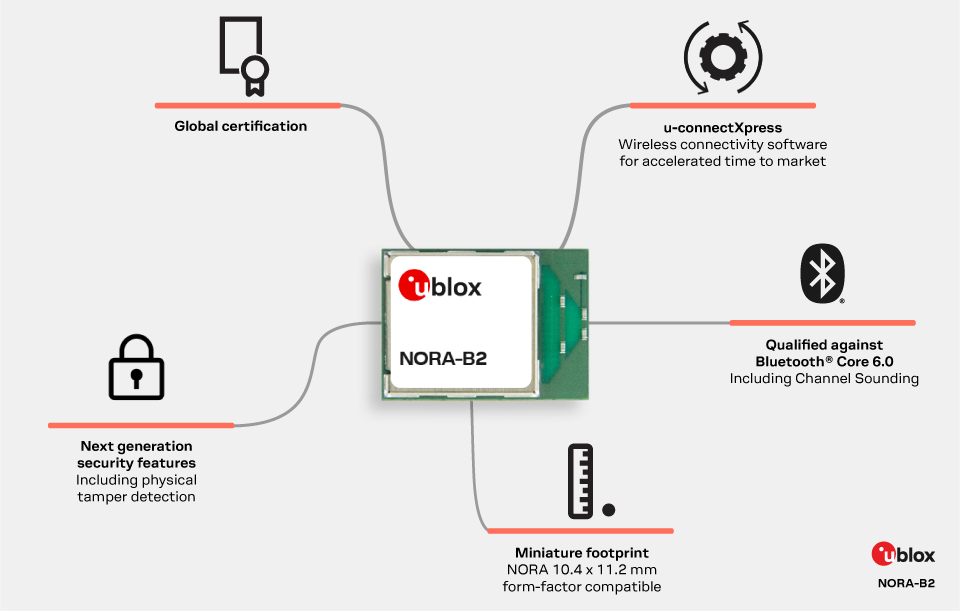
Our NORA-B2 series exists for teams that need professional-grade Bluetooth LE hardware with a spectrum of choices – different antenna options, memory sizes, and software paths – including the zero-code simplicity of u-connectXpress. All NORA-B2 modules are built on Nordic Semiconductor’s latest nRF54 series chips and are qualified to Bluetooth® Core 6.0, giving you a modern, future-proof platform to grow on. These modules deliver strong processing power, making them suitable for demanding IoT applications that require reliable performance. They also come with global radio certifications out of the box, so you have one less hurdle to clear on the road to market. Their flexible design allows you to connect other devices, such as additional sensors or peripherals, to expand system functionality. Below are the two u-connectXpress variants in the family:
NORA-B26 is the feature-rich option in the series, ideal when your design demands maximum flexibility and headroom. It offers more memory and advanced feature support, plus flexibility in antenna choice – including variants with an external antenna connector for specialized use cases. NORA-B26 delivers strong processing performance with enough headroom to handle demanding IoT applications, enabling more complex tasks and enhanced device functionality. The module features comprehensive input/output capabilities for device interaction, including security input options for Bluetooth connections and device interfaces. Specific bits within configuration or security parameters can be set to influence device behavior, address identification, or enable advanced security features. In short, NORA-B26 gives you room to grow (new features, or updates) on a Bluetooth 6.0 foundation, while still letting you enjoy the simplicity of the u-connectXpress AT-command interface.
NORA-B27 is the cost-optimized sibling – built for high-volume IoT designs that don’t need every bell and whistle. It is ideal for low-power applications where minimizing energy consumption is critical for device longevity, and it’s well-suited for remote deployments (think environmental sensors or asset trackers in locations with limited access to power). The module enables IoT devices to efficiently collect data from sensors over extended periods without frequent maintenance, making it perfect for scenarios where long battery life is essential. It strips down to the essential features to minimize unit cost, without compromising on core connectivity or quality. You get the same u-connectXpress experience as its big sister, meaning the path from development kit to prototype to final device stays fast and straightforward. And because it shares the same u-connectXpress “DNA” as NORA-B26, moving between the two variants or designing a product line with both is frictionless. Both modules support industrial temperature ranges (-40 °C to +85 °C) to ensure reliability from the lab to the field. And both come with the backing of u-blox’s Swiss-engineered quality and global support network, so you can design with confidence.
Choosing the right module: In summary, consider your project’s needs to pick the best fit:
Whichever you choose, you’re still speaking “AT” – not wrangling low-level Bluetooth details. That’s the point.
What does making Bluetooth LE integration simple look like in practice? Here are a few ways developers are using u-connectXpress and NORA-B2 modules to accelerate IoT projects:
Many developers use Bluetooth LE to eliminate serial cables or UART links in legacy systems. With u-blox modules, you can use the Serial Port Service (SPS) feature to achieve this. It’s ideal when you need a persistent connection to another Bluetooth LE device and want to send any type of data at any time.
Depending on your use case or preference, you can either handle communication through AT commands or enable transparent data transfer, meaning data passes untouched from one side of the “cable” to the other. For maximum efficiency, you can choose to send data in binary mode instead of string mode. To your application, it feels as if a serial cable were plugged in – except there’s no cable, and you didn’t have to become a Bluetooth expert to make it work.
All link maintenance happens automatically behind the scenes, so to your microcontroller it’s as if data is simply flowing over a wire. This kind of drop-in cable replacement is a boon for retrofitting equipment or creating wire-free versions of existing products. Devices can be easily integrated for cable-free connectivity without redesigning their entire communication stack.
Another common use case is a companion device that communicates with a smartphone or tablet — for example, a diagnostic tool, wearable, or industrial sensor paired with a mobile app. Using u-connectXpress gives you a stable, well-tested command set to manage the Bluetooth LE link, ensuring the device and phone connect reliably every time. This is ideal for field tools and consumer devices where the connection must work out-of-the-box, providing a seamless and dependable experience for users.
Instead of spending time dealing with Bluetooth nuances or mobile OS quirks, you simply use the AT command interface to exchange data with the app. Once a connection is established, the mobile app typically acts as a GATT client and reads data exposed by the device through GATT services and characteristics. If larger amounts of data need to be transferred, the phone can set up an SPS channel to the device for greater efficiency. You can also imagine the smartphone app acting as a gateway, providing internet access to send larger diagnostic files or aggregated data to the cloud.
The first-time connection success rate is high, maintenance requirements are low, and your development team can focus on app logic and device functionality rather than debugging wireless protocols. In effect, u-connectXpress gives even small teams the confidence to deploy Bluetooth-enabled products that feel polished and just work for the end user.
Think of a battery-powered environmental sensor hub designed to monitor environmental parameters such as temperature and humidity. The hub wakes up, collects sensor data, and publishes them wirelessly on a schedule. The device can sense changes in environmental conditions and report them wirelessly for remote monitoring and data collection. Traditionally, you’d choreograph complex power-state transitions and Bluetooth LE connection events to optimize battery life. With u connectXpress, much of this is handled through a few clear commands: enter deep sleep, wake and advertise, send data, then return to sleep. The module’s firmware takes care of the nitty-gritty (like managing connection intervals and advertising parameters) to maximize battery life. You get an efficient sensor hub without having to become an expert in Bluetooth LE power management – yet your devices can reliably stay in the field on a tiny battery, waking only when needed.
Engineering is often about trade-offs, but with the right module you can balance performance, power, and price without the usual compromises. NORA-B27 is designed to achieve this balance – delivering robust connectivity and ultra-low power consumption while still hitting cost targets for battery-driven, high-volume IoT devices. In fact, NORA-B27’s power consumption and wireless performance are on par with other leading Bluetooth LE modules, ensuring you don’t give up anything critical by choosing a cost-effective solution. You also benefit from the latest Bluetooth features (thanks to Bluetooth 6.0 qualification) and next-gen security features (like secure boot and link encryption) built right in. And because u-blox provides free access to software tools, code examples, and documentation, it’s easy for engineers to evaluate and integrate NORA-B27 without added cost or friction. In short, you get affordability without settling for “cheap” – you get a module that’s fit for purpose.
Meanwhile, if your use case demands the higher-end specs of NORA-B26, you’re still not forced into trade-offs – you gain the extra capabilities and keep the simplicity and low-power operation that the NORA-B2 family is designed for. Both modules share a common software interface and design ethos, so you can choose based on features and cost, not on which one is easier to integrate (they’re equally easy).
Adopting u-connectXpress on NORA-B2 modules isn’t just about technical elegance – it directly benefits your project’s timeline and success. Here are a few reasons developers and product teams choose this approach:
If you’re considering building sensor hubs, beacons, cable-replacement links, or phone-connected tools, the combination of u-connectXpress + NORA-B2 lets you move from idea to prototype to product with far less drama and far more certainty. Our goal is to give you time back for the parts of your project that only you can do – while we handle the wireless connectivity plumbing in the background. With u-blox as your partner, you’re not just buying a module; we’re helping you reliably connect your innovation to the world.
Simplify Bluetooth LE integration and accelerate your IoT roadmap:
Magnus Johansson: Senior Product Line Manager – Product Strategy Short Range, u-blox
Get in touch for orders or any queries: sales@rfdesign.co.za / +27 21 555 8400
Courtesy of u-blox[/vc_column_text][/vc_column][/vc_row]