
Knowles Precision Devices is well known for expertise in delivering high-performance mmWave filtering options. But did you know that Knowles Precision Devices also excels at providing a wide variety of lower-frequency filtering options using a lumped element filter construction? In this blog post, Knowles Precision Devices explores the basics of lumped element filter design, general lumped element filter characteristics, and how Knowles Precision Devices pushes lumped element filter design limits to develop a wide variety of high-performance, low-frequency filtering options.
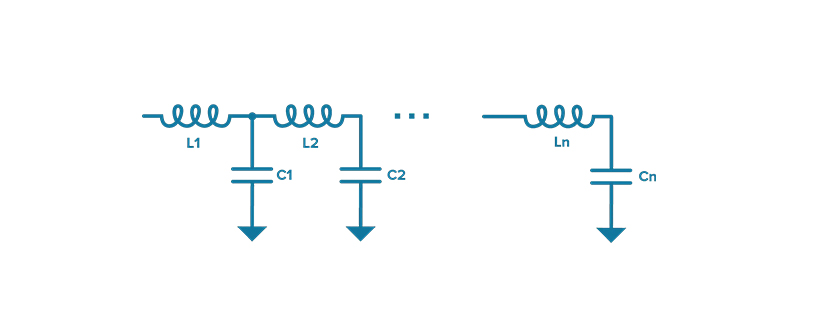
In general, lumped element filters are passive filters constructed using the appropriate number of inductors (Ls), capacitors (Cs), and resistors (Rs) to meet the specific filtering needs of a particular application. At the most basic level, lumped element filters can be constructed from a collection of simple LC resonators, as shown in Figure 1.
Figure 1. An example of a generic lumped element L-C structure.
The resonators used in the filter create poles and zeros in the frequency response. A zero occurs when the function tends to zero, and a pole occurs when the roots make the function tend toward its maximum value. By understanding how poles and zeros function, resonators can be constructed using Ls and Cs, and the poles and zeros can be placed where needed to tightly control the frequency response.
Lumped element filters offer a small size at low frequencies that is not achievable with common ceramic, cavity, or waveguide implementations. Additionally, lumped element filter designs are highly customizable in terms of electrical performance, as well as mechanical and thermal characteristics. This is because Knowles Precision Devices has a high level of control over component and material choices, as well as assembly techniques. For example, a lumped element filter can be constructed to withstand temperature and input power ranges that may not be possible with alternative resonator technologies.
All the usual filter types can be implemented in a lumped element format, including lowpass, high-pass, bandpass, and band-reject filters. As discussed in more detail in the Designing Basic Filter Circuits blog, lowpass and high-pass elements are relatively simple to develop, and bandpass filters can be constructed by combining the two behaviors.
Knowles Precision Devices offers lumped element filter options that cover the frequency and bandwidth range shown in Figure 2 below.
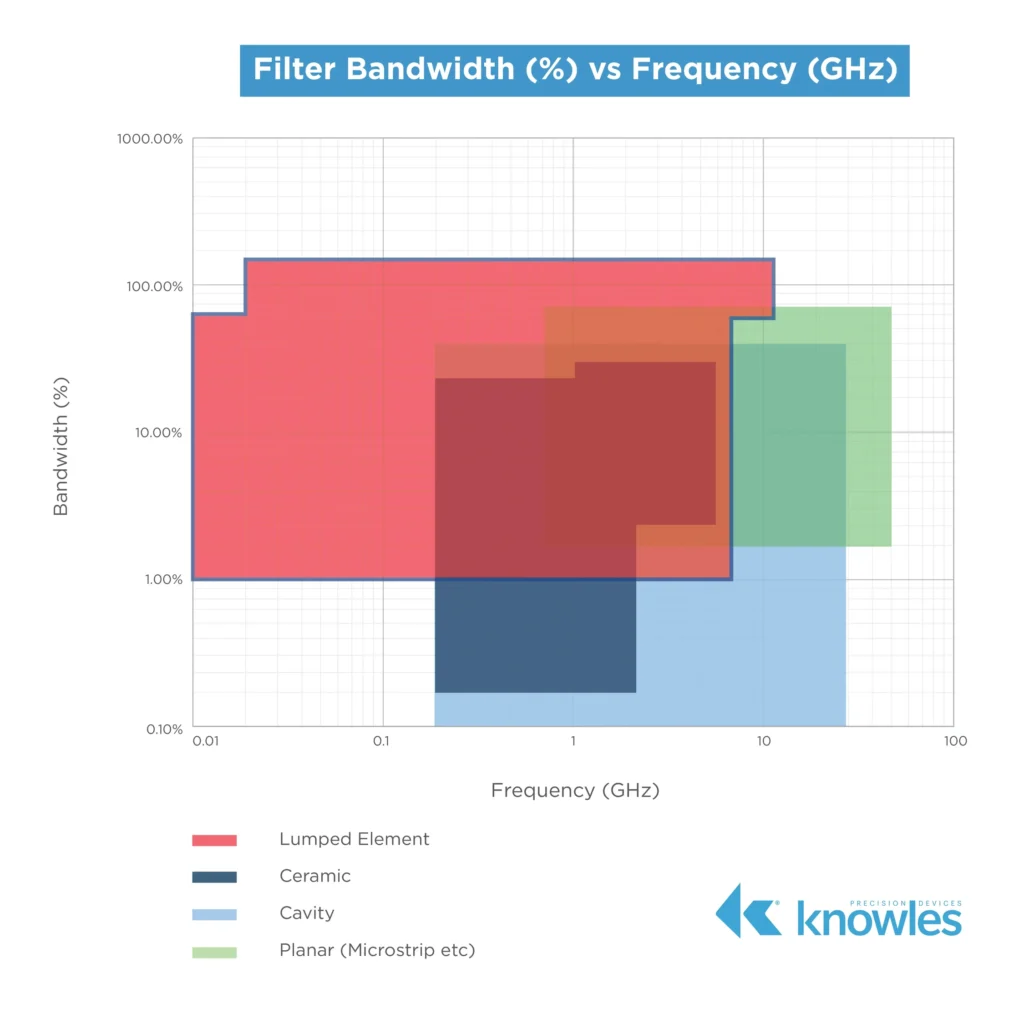
Figure 2. The frequency range covered by Knowles Precision Devices lumped element filters is shown in the red area highlighted with a blue outline.
Unlike many suppliers, Knowles Precision Devices uses advanced modeling and design capabilities to achieve virtually any filter response shape. Knowles Precision Devices also customizes lumped element filters to operate reliably in high-power, high-temperature, and harsh environmental conditions. More specifically, Knowles Precision Devices lumped element filters can be designed with the following specifications:
Explore the wide range of lumped element filter options by downloading the RF Filters catalog, or learn more about other common filter types, including cavity, ceramic coaxial, and microstrip.
Get in touch for orders or any queries: sales@rfdesign.co.za / +27 21 555 8400
Courtesy of Knowles