[vc_row][vc_column][vc_column_text css=””]
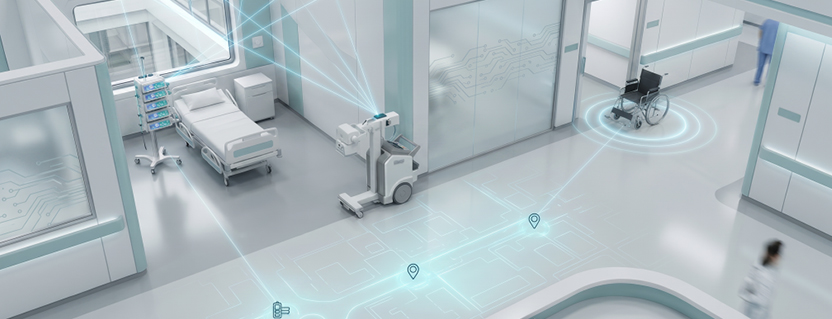
Ask a clinical engineer at any mid-to-large hospital system what their biggest operational headache is, and the answer is rarely a clinical one. It’s the infusion pump that the system says is in Bay 9 but is physically somewhere on the third floor. It’s the wheelchair logged as available that a housekeeper moved to a break room two shifts ago. It’s the portable X-ray machine whose last-known location is from Tuesday.
Healthcare asset tracking has been a solved problem on paper for twenty years. In practice, the technologies that tracking — primarily passive RFID and Bluetooth Low Energy — have never quite kept pace with the operational demands placed on them. Room-level accuracy isn’t enough when clinical workflows depend on knowing which side of a double-occupancy room an asset is on. Qorvo Ultra-Wideband RTLS doesn’t iterate on those limitations. It eliminates them.
BLE triangulation in a hospital RF environment is a fundamentally difficult problem. The same infrastructure that makes hospitals function — metal bed frames, mobile imaging equipment, dense Wi-Fi access points, elevator shafts, and lead-lined walls — creates a multipath environment that unpredictably degrades 2.4 GHz signals. Published BLE RTLS accuracy in clinical environments ranges from 1-3 meters in favourable conditions to effectively unusable in challenging ones.
Passive RFID trades multipath sensitivity for range limitations and the frequent false reads that occur near doorways and hallway intersections. A tag physically located in the corridor between two bays can appear in either — or neither — depending on reader geometry and ambient interference. That ambiguity erodes clinical trust in the system and ultimately drives staff to stop relying on it.
UWB’s operating bandwidth — spanning 500 MHz or more of instantaneous spectrum — gives it a time-domain resolution that narrowband technologies cannot approach. It resolves multipath components that BLE blurs into a single received signal, producing ranging measurements accurate to under 15 cm in two dimensions. When an asset tag reports a position, it reports where that asset actually is — and that consistency is what makes UWB RTLS trustworthy enough to build clinical workflows around.
The operational impact of moving from room-level to centimeter-level accuracy isn’t linear — it’s categorical. Capabilities that were not viable with legacy RTLS become routine:
Hospitals are among the most difficult buildings in the world to navigate. A major teaching hospital can occupy hundreds of thousands of square feet across multiple interconnected wings, basement levels, and tower blocks — each added in a different decade, with its own floor plan logic. For patients arriving anxious and unwell, for visitors unfamiliar with the site, and for newly appointed staff covering an unfamiliar wing, getting lost isn’t a minor inconvenience. It causes missed appointments, delayed procedures, and real operational cost.
GPS, the default navigation solution in every other context, stops working the moment someone steps through the entrance doors. The same UWB anchor infrastructure deployed for asset tracking is inherently capable of supporting turn-by-turn indoor navigation — at the same sub-15 cm accuracy that makes it clinically credible. A patient’s smartphone, a visitor’s app, or a staff member’s badge can all be positioned on a live floor plan and guided to a destination without any additional hardware investment beyond the RTLS infrastructure already in place.
The patient-facing application case is particularly compelling. A patient arriving for a pre-operative assessment receives a notification as they enter the building, and the hospital app transitions automatically from outdoor map to indoor navigation mode — guiding them corridor by corridor, with alerts for lifts, accessible routes, and department check-in points. For elderly patients, those with cognitive impairment, or anyone attending a large complex site for the first time, that guidance meaningfully reduces anxiety and missed attendance. And because the same infrastructure generates all position data, the wayfinding layer adds no RF complexity to an already demanding clinical environment.
Understanding the engineering architecture beneath the clinical outcomes is essential for teams scoping a deployment. A hospital UWB RTLS system operates across three distinct layers.
The Radio Layer is where physics meets precision. Tags attached to assets, worn by staff, or integrated into patient wristbands transmit UWB pulses — short bursts of energy spread across a wide spectrum at very low power. Ceiling- or wall-mounted anchors receive those pulses and timestamp them with sub-nanosecond precision.
The Location Engine transforms timestamps into coordinates. A server-side or edge-compute engine applies multilateration algorithms to timestamp data from multiple anchors, computing (x, y, z) position fixes for each tag. Kalman filtering smooths position estimates over time and suppresses the effect of transient multipath events — a supply cart blocking a line of sight, a mobile imaging unit parked near an anchor. Output is a continuous position stream per tag at 1–10 Hz update rates.
The Application Layer puts coordinates to work. Standard REST, MQTT, and AMQP interfaces connect the location engine to clinical software — asset management platforms, nurse call systems, EHR integrations, real-time dashboards, and wayfinding applications. Hospitals don’t need proprietary middleware or a full system replacement to add UWB RTLS to an existing digital infrastructure stack.
The topology decision sits at the intersection of accuracy, scalability, and operational economics — and it carries significant infrastructure implications that must be resolved before the first anchor goes in.
Two-Way Ranging (TWR) initiates bidirectional ranging sessions between tags and anchors. It delivers high accuracy and high update rates, and is the simpler of the two architectures to implement. Its limitations are tag capacity — typically in the hundreds per infrastructure — and tag power consumption, which reduces battery life to months. TWR is best suited to high-value equipment tracking in high-acuity zones like ICUs and procedure rooms where real-time update frequency justifies the infrastructure cost.
Time Difference of Arrival (TDoA) flips the architecture. Tags transmit unilaterally; anchors listen passively; the location engine does the computation. This design scales comfortably to thousands of simultaneous tags on a single infrastructure, with tag battery life extending to years. For a 500-bed hospital tracking thousands of assets and staff badges simultaneously, TDoA is the architecture that makes per-unit operational economics viable.
Critically, the hardware doesn’t force the choice. The Qorvo DWM3000 — a compact 23 × 13 × 2.9 mm module integrating the DW3110 UWB IC, ceramic antenna, power management circuitry, and a precision crystal — supports both TWR and TDoA from the same hardware platform. A hospital can standardize on a single hardware design and configure topology per zone: TWR in the cardiac ICU, TDoA across general wards.
For clinical technology teams developing custom tag hardware before committing to a production PCB, the DWM3000EVB evaluation board provides an Arduino-compatible development platform with an onboard 3.3 V DC-DC converter and current measurement jumper for power profiling — the right starting point for any hospital RTLS build.
Qorvo’s DW3xxx and QM3xxx SDK provides production-ready anchor and tag firmware for both TWR and TDoA topologies, along with anchor calibration and position survey tools that significantly reduce the integration burden for clinical technology teams and RTLS system integrators building on the platform.
Sub-15 cm accuracy in a ward environment is achievable with anchors mounted at 3-4 meter ceiling height and spaced 8-12 meters apart along corridors, with denser placement in procedure rooms and ICUs. A typical 30-bed ward requires between 12 and 20 anchor points — a one-time infrastructure investment with a service life measured in decades, not product cycles.
The DWM3000 is in full production, RoHS compliant, and available through Qorvo’s authorized distributor network.
The global healthcare RTLS market reached $2.2 billion in 2025 and is growing at a 10.8% CAGR, projected to reach $7.0 billion by 2036. UWB is not a future consideration in this market — it is the current premium tier, winning clinical specifications where accuracy, scalability, and enterprise integration requirements have outgrown what BLE and RFID can reliably deliver.
The next generation of hospital operations is built on the assumption that location data is accurate enough to be trusted automatically — by software systems, by clinical workflows, and by the staff who depend on them every shift. Qorvo’s Ultra-Wideband platform is how that assumption becomes a deployable reality.
Your car. Your smartphone. Your wrist. Your heart. Even outer space. Qorvo products are at work connecting, protecting and powering the planet. We bring core radio frequency (RF) and power technologies and solutions to mobile, infrastructure, the IoT, defense/aerospace and power management markets.
Get in touch for orders or any queries: sales@rfdesign.co.za / +27 21 555 8400
Courtesy of Qorvo[/vc_column_text][/vc_column][/vc_row]
We use cookies to improve your experience on our site. By using our site, you consent to cookies.
Manage your cookie preferences below:
Essential cookies enable basic functions and are necessary for the proper function of the website.
Statistics cookies collect information anonymously. This information helps us understand how visitors use our website.
Google Analytics is a powerful tool that tracks and analyzes website traffic for informed marketing decisions.
Service URL: policies.google.com (opens in a new window)
Google reCAPTCHA helps protect websites from spam and abuse by verifying user interactions through challenges.
SourceBuster is used by WooCommerce for order attribution based on user source.