

[vc_row][vc_column][vc_column_text css=””]
If you’re an engineer designing or deploying high-precision GNSS systems in Brazil, you’re working in one of the most ionospherically challenging environments on Earth. Brazil sits along the geomagnetic equator, where ionospheric disturbances are stronger, more frequent, and more operationally disruptive than almost anywhere else in the world.
Understanding why this happens, and what modern correction services can do about it, is essential for anyone building reliable precision positioning systems in the region. It’s also the central topic of our upcoming webinar:
Date: June 17, 2026
Time: 10:00 AM (GMT-3)
In Brazil, planting a 100-hectare sugarcane field using precision agriculture can take approximately 15 hours. With multiple fields to manage, farmers are under constant pressure to work efficiently. Yet even well-calibrated tractors that typically follow perfectly straight guidance lines can begin to drift, struggle to acquire high-accuracy positioning after startup, or in some cases halt operations entirely due to position uncertainty. This challenge is compounded by Brazil’s location near the magnetic equator, where ionospheric disturbances can cause sudden signal degradation, making reliable GNSS positioning particularly difficult to maintain across long planting sessions.
This inconsistency can result in over-seeding, wasted fuel, and increased operator intervention. In time-sensitive operations such as planting or spraying, even brief periods of degraded accuracy can carry measurable economic consequences, especially across large fields.
The ionosphere is a layer of Earth’s upper atmosphere that stretches from roughly 60 to 1,000 kilometers above our planet’s surface. It is filled with charged particles produced by solar radiation. As GNSS signals travel down through this layer on their way to your receiver, they slow down and scatter in ways that directly affect positioning accuracy.
This manifests in two ways for high-precision applications:
A slowing of the signal that introduces ranging errors, which then compound into position errors. Standard correction models address perhaps 50–70% of this effect, which is not nearly enough for centimeter-level GNSS accuracy.
Rapid signal fluctuations caused by small electron density pockets in the ionosphere that can cause receivers to lose satellite lock entirely, creating gaps in positioning availability.
Both effects are worse near the geomagnetic equator. In Brazil, scintillation is not an edge case. It’s a routine operational reality, which means any precision positioning system deployed here must be designed with ionospheric resilience as a first-order requirement, not an afterthought.
Together with our partner, Nordian, we have been continuously monitoring positioning PPP-RTK network performance across Brazil under real ionospheric conditions.
The results demonstrate what’s possible when hardware and correction services work together. During a 24-hour monitoring period featuring high ionospheric activity, horizontal position error remained stable throughout, even as ionosphere index levels climbed from medium to high. Over a full month of testing in July 2025, fix percentages remained consistently high across test locations spanning the country, with RMS horizontal accuracy in the low centimeter range.
This isn’t lab performance. It’s field performance under difficult conditions in Brazil.
Achieving this level of resilience requires more than a good receiver. It requires the right combination of hardware architecture and correction service.
On the hardware side, u-blox RTK modules are integrated directly into Nordian boards available in Brazil. They use multi-band signal tracking across multiple GNSS frequencies simultaneously. When scintillation disrupts one frequency, the receiver draws on others to maintain lock and continue computing an accurate position. This hardware-level redundancy is fundamental to ionospheric resilience.
On the corrections side, PointPerfect Flex uses PPP-RTK technology: real-time precise corrections generated from a dense network of reference stations, delivered directly to the rover without requiring a local base station. Compared to traditional RTK, which depends on proximity to a physical base, or standalone PPP, which typically requires a long convergence time, PPP-RTK offers a compelling middle ground: It offers fast convergence, wide-area coverage, and ionospheric corrections that account for over 95% of the total error.
For engineers working across Brazil’s vast geography, this distinction matters enormously. Local RTK infrastructure is expensive to deploy and maintain, and coverage is inherently limited. A correction service that delivers centimeter accuracy across the entire country, including in remote agricultural and industrial regions, fundamentally changes what’s achievable.
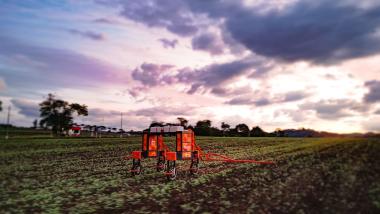
Nordian and Hural transform robotic agriculture

Unlocking the Power of Precision Agriculture with Nordian’s OEM Board and PX9 Solution
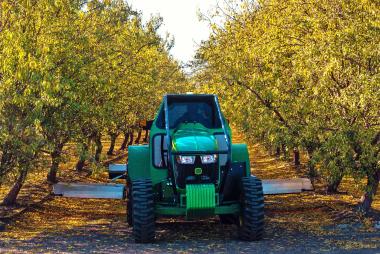
Simplifying precision agriculture with robust, affordable, and reliable GNSS
The data and architecture above are a starting point. In the upcoming webinar, we’ll go significantly further, working through reliability strategies for real-world deployments, and walking through hands-on product solutions based on u-blox modules and Nordian’s network.
Whether you’re evaluating correction service architectures, designing systems for agricultural automation, or trying to understand how to maintain positioning availability during ionospheric storms, this session is built for you.
Date: June 17, 2026
Time: 10:00 AM (GMT-3)
Get in touch for orders or any queries: sales@rfdesign.co.za / +27 21 555 8400
Courtesy of u-blox
[/vc_column_text][/vc_column][/vc_row]