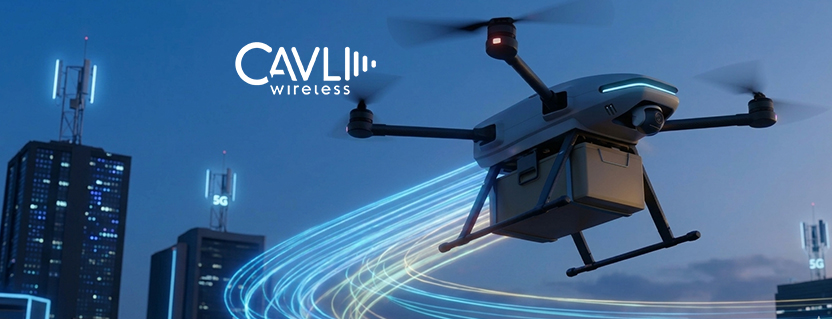
For drone OEMs, ODMs, and IoT design houses, connectivity is one of the most critical design decisions to address early in the development cycle. As commercial drone deployments expand across agriculture, logistics, aerial monitoring, and emergency response solutions, system designers must address a demanding set of requirements: high-throughput video transmission, low-latency control, reliable positioning, onboard application processing, and consistent network availability under varying field conditions.
The technical hurdle is especially clear in applications that require precise and real-time control. A drone operating in Beyond Visual Line of Sight (BVLOS) workflows may need to transmit high-resolution video to a controller or command center while simultaneously sending telemetry, receiving control inputs, processing local logic, and maintaining positioning accuracy. For fast maneuvers, the delay between operator command and drone response must remain as low as possible. For video-assisted navigation or inspection, the available downlink capacity must support continuous, high-quality streams. For enterprise deployments, the connectivity layer must also be supported by a development ecosystem that enables OEMs to reduce integration complexity and accelerate time to market.
Cavli’s 5G module portfolio, comprising the CQM211, CQM212, and CQM215, is designed to support high-performance IoT and drone applications that require 5G NR connectivity with LTE fallback. These modules provide OEMs with a scalable foundation for building drone platforms that must operate reliably in demanding enterprise environments.
The CQM211 supports 5G NR Sub-6 with LTE Cat 16 fallback and is based on the SDX61 chipset. It delivers up to 2.4 Gbps downlink and 900 Mbps uplink in 5G NR SA, and up to 3.4 Gbps downlink and 500 Mbps uplink in 5G NR NSA. The module incorporates a quad-core Cortex-A7 processor up to 1.8 GHz, on an OpenWrt platform, diversity, L1+L5 GNSS, and eSIM capability on the M.2 variant. For compact drone platforms that require robust 5G performance and practical integration flexibility, the CQM211 provides a capable entry point.
The CQM212 is positioned for higher-bandwidth applications, offering 5G NR speeds of up to 5.36 Gbps downlink and 1.25 Gbps uplink, with LTE Cat 20 fallback. Built on the SDX82 chipset, it features an Arm Cortex-A55 processor up to 2.2 GHz, Linux support, 100 MHz bandwidth, diversity, and L1+L5 GNSS. Its GNSS engine is capable of supporting GPS, GLONASS, BeiDou, Galileo, QZSS, and NavIC through the transceiver interface, making it relevant for geographically diverse drone deployments.
The CQM215 further extends performance with the SDX85 chipset, 5G NR speeds of up to 7.01 Gbps downlink and 1.25 Gbps uplink, LTE Cat 20 fallback, 100 MHz bandwidth, diversity, 4CA, L1+L5 GNSS, in an LGA package. It is suitable for advanced platforms that must support richer payload data, multiple concurrent data streams, or more bandwidth-intensive mission profiles.
In the context of Cavli’s 5G portfolio, EDGE refers to the low-latency connectivity enabled by Cavli’s 5G NR and 5G RedCap-class capabilities. For drone applications, this connectivity profile is critical because operational effectiveness depends on how quickly data moves between the drone, operator, cloud platform, and enterprise application backend.
Throughput ranging from 3.4 Gbps to 7.01 Gbps across the portfolio enables bandwidth-intensive use cases such as live video streaming, aerial imaging, sensor data transfer, and mission telemetry. Low-latency communication supports responsive command-and-control workflows, particularly where drones must execute quick maneuvers or operate in dynamic environments.
For example, an agricultural drone may need to capture crop imagery, stream live video to an operator, upload field data to a farm management platform, and receive route adjustments based on crop zones or spray plans. A logistics drone may need to manage payload status, flight path updates, landing-zone validation, video feeds, and remote intervention. In both scenarios, the connectivity module directly influences system responsiveness, operational continuity, and the quality of user experience.
For OEM engineering teams, Cavli’s 5G modules offer more than cellular access. The modules enable system architects to simplify connectivity design while retaining flexibility for application-specific customization in drone powered use cases. For engineering teams, this matters at the integration level. Instead of pairing a discrete cellular modem, external GNSS receiver, and separate host MCU for every connectivity task, the module can support local services such as link monitoring, mission-state reporting, failover rules, and field diagnostics.
Get in touch for orders or any queries: sales@rfdesign.co.za / +27 21 555 8400
Courtesy of Cavli Wireless
We use cookies to improve your experience on our site. By using our site, you consent to cookies.
Manage your cookie preferences below:
Essential cookies enable basic functions and are necessary for the proper function of the website.
Statistics cookies collect information anonymously. This information helps us understand how visitors use our website.
Google Analytics is a powerful tool that tracks and analyzes website traffic for informed marketing decisions.
Service URL: policies.google.com (opens in a new window)
Google reCAPTCHA helps protect websites from spam and abuse by verifying user interactions through challenges.
SourceBuster is used by WooCommerce for order attribution based on user source.