

Exploring the potential and challenges of LEO for PNT applications.
The Global Navigation Satellite System (GNSS) comprises four satellite constellations, each with its own set of Medium Earth Orbit (MEO) satellites that revolve about 20,000 km above the Earth. With nearly 130 satellites in outer space, GNSS supports Positioning, Navigation, and Timing (PNT) applications worldwide. GNSS does not operate alone; regional satellite navigation systems enhance services in regions with limited access. Additionally, with satellite-based augmentation systems (SBAS) employing geostationary satellites located above the areas they serve, it is possible to reduce the errors affecting the information received from the GNSS satellites.
Despite the many advances in PNT applications from the 1970s to today, the technology has certain drawbacks, including weak signals that can be jammed, signals unable to pass through buildings or be received when the sky is obstructed, and susceptibility to multipath effects, particularly in urban canyons. These issues may degrade the signals and reduce overall performance.
As time goes by, solutions to address these challenges have arisen. Yet, there is also the possibility of approaching the problem from a completely different perspective, such as considering other types of satellites, especially with the rise of satellite communication networks in recent decades.
Low Earth Orbit (LEO) satellites orbit the Earth at altitudes of 400 to 1500 km. They are smaller and cheaper to manufacture and deploy, as the low earth orbit altitude considerably reduces launch costs. However, their coverage range is also reduced by a factor of 4 to 16 times. LEO satellites are part of what is now known as non-terrestrial networks (NTNs).
Today, NTNs are primarily used to extend cellular networks and provide voice and data connectivity to users worldwide. End applications utilizing modules with access to cellular and satellite networks can now achieve coverage in remote and isolated areas, thanks to emerging “roaming” business models rapidly gaining traction.
Visionaries have recognized the potential of LEO satellite constellations for other applications, including PNT. This brings us to the entry title: Are low earth orbit satellites the next frontier for PNT applications, either on their own or in conjunction with MEO satellites?
Through extensive ongoing research, experts have been examining the potential advantages and disadvantages that LEO satellites could offer. The answer to the question is by no means straightforward. Instead, given the many stakeholders involved, it raises numerous possibilities and uncertainties that require careful consideration.
In this case, a single change in a variable lead to numerous technological considerations that ultimately impact communication between satellites and receivers. The image below outlines some of the implications of changing the distance between the surface of the earth and the satellite.
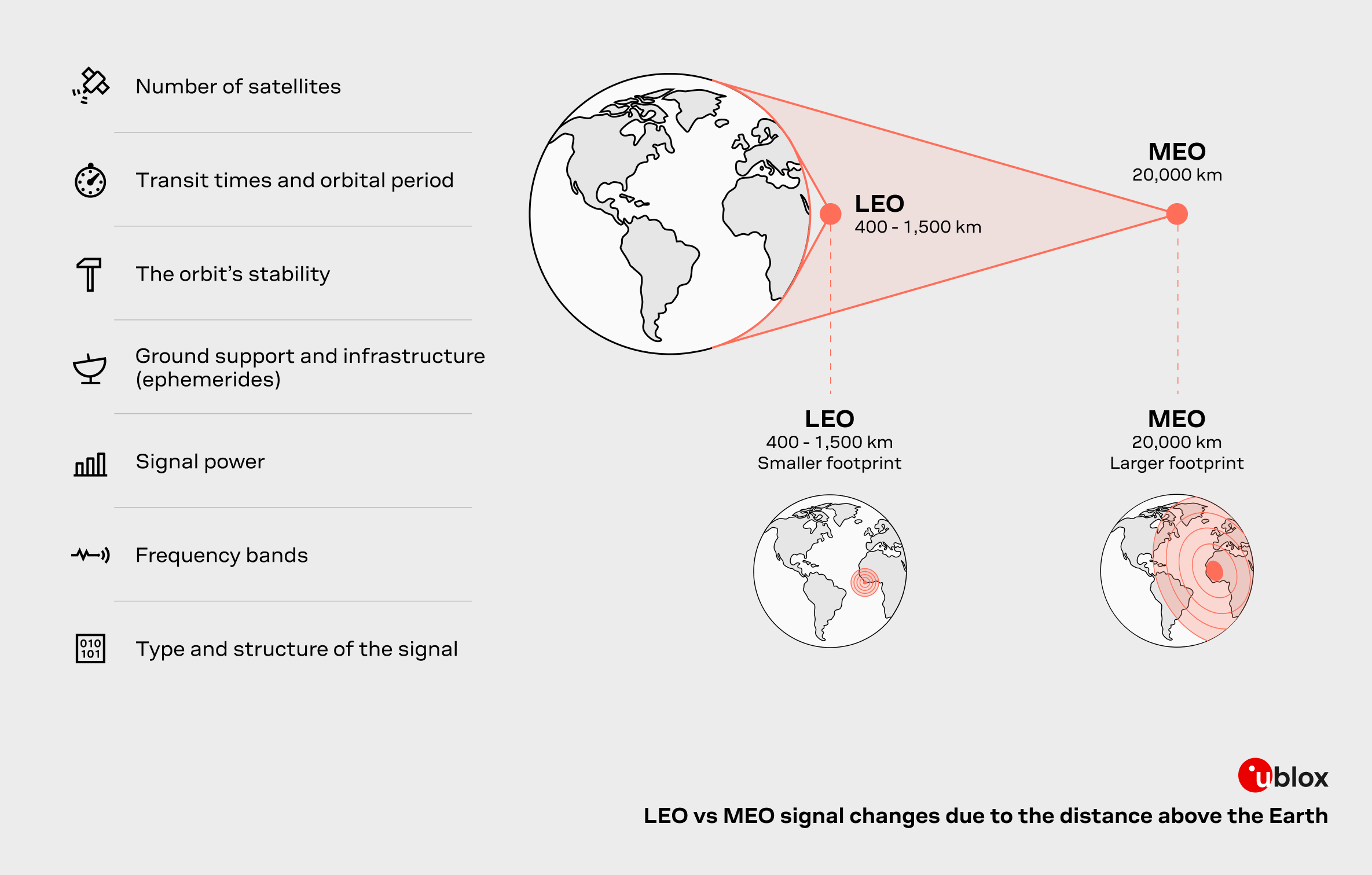
Many recent publications and information on various websites suggest that LEO PNT offers significant advantages and represents the way forward. While basing PNT applications on LEO satellites may provide numerous benefits, it is essential to also look at the other side of the coin and consider the challenges this technology entails.
So, let’s delve into what these implications represent from both positive and negative perspectives.
A common understanding is that the more visible satellites there are, the more accurate end-user applications can become. Still, with current MEO constellations enabling visibility of up to 40 satellites, having more satellites does not necessarily translate into additional accuracy benefits.
The orbits of LEO satellites are less stable than those of MEO satellites. This instability occurs mainly because, at their operating altitudes, the uneven distribution of mass within the Earth affects the gravitational forces acting on satellites, leading to less stable orbits and a higher potential for orbital errors. If these errors are not addressed through advanced orbital ephemerides – detailed models that track the positions and movements of satellites – the inaccuracies can undermine advantages such as signal strength and reduced latency.
While LEO satellites have the potential to enhance communication and positioning services, their effectiveness relies on precise orbital modeling; otherwise, these benefits may be overshadowed by the challenges posed by orbital inaccuracies.
A common assumption holds that signal power and indoor coverage are directly correlated; however, this relationship does not straightforwardly apply to RNSS bands (L1, L2, L5, and L6). To clarify this point, it is important to distinguish between the power that a satellite transmits and the power that a receiver ultimately captures on the ground. LEO satellites orbit at considerably lower altitudes than the MEO satellites used in conventional GNSS, which means that a given level of received power can, in principle, be achieved with a lower level of transmitted power. This proximity is exactly what allows LEO satellites to operate with reduced power, lowering satellite costs, and enabling smaller designs. Nevertheless, a lower altitude does not, on its own, translate into stronger signals received at ground level, since the altitude advantage and the reduction in transmit power can offset one another, and therefore the net signal received by users is not inherently improved simply by switching to LEO.
New bands such as S, C, and K could be used to transmit signals, leading to enhancements in signal power, and would also help to manage ionospheric effects. However, a price must be paid: more complex receiver components would increase expenses and drain energy from the receivers, along with additional cost and complexity for the antennas.
As mentioned above, the use of LEO satellites does not necessarily lead to higher signal power for receivers. Such an improvement would occur only if new radio bands were utilized, while also considering the added complexity for receivers. In other words, the potential gain stems from the new frequency bands and the signal design rather than from the lower orbit itself.
Traveling from one side of the world to the other, from horizon to horizon, is much faster for a LEO satellite than for a MEO satellite; as the distance it covers decreases, the orbital velocity increases. Consequently, receivers are constrained to acquire signals in a fast manner and are exposed to larger Doppler shifts. Is this a more complex process? Yes. Does it mean that the new signal characteristics could offer other advantages? Another yes.
The faster motion of satellites over the sky also impacts high precision positioning, as the relative position of LEO satellites to users on the ground changes more rapidly than those of satellites in higher orbits. This allows the receiver to resolve carrier phase ambiguities more quickly. For methods such as RTK and PPP, this helps by reducing convergence time, as the system can gather diverse satellite data faster, and achieve an ambiguity resolved high precision position solution quicker.
Multipath mitigation is another area where a faster-changing radio path could make a difference. In a LEO satellite system, the dynamic nature of the satellite movement helps mitigate multipath issues. Rapid changes in the channel lead to swift environmental changes, reducing the likelihood of persistent interference from the same reflections.
Leveraging current signal processing techniques and employing extended and coherent signal integration receivers could more effectively mitigate varying multipath conditions, leading to improved multipath mitigation. Therefore, the design of the constellation of satellites and the method by which the receiver processes the signals are essential for a LEO PNT application to provide multipath mitigation and resilience with a higher degree of robustness.
A final point, unrelated to the distance variable, is that LEO satellites have a shorter lifetime than MEO satellites. Replacing these smaller and cheaper satellites paves the way for technological enhancements with each replacement. New features could be introduced more quickly than those incorporated into MEO constellations.
While LEO satellites possess several characteristics that could enhance PNT applications, owners and receiver manufacturers must consider the points mentioned above. Otherwise, improving performance through these satellites could become a mere illusion rather than a practical reality.
Get in touch for orders or any queries: sales@rfdesign.co.za / +27 21 555 8400
Courtesy of u-blox