
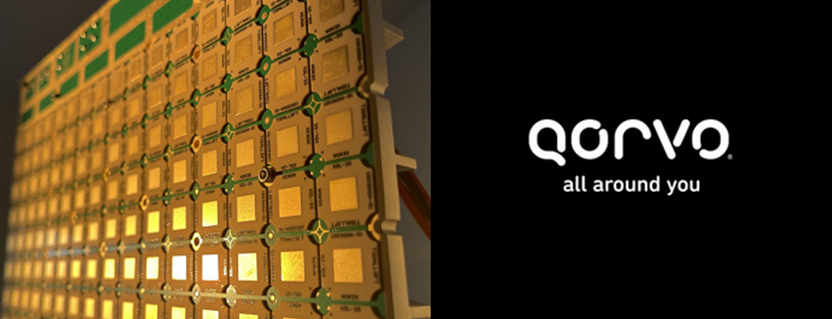
Modern X-band radar systems increasingly rely on Active Electronically Scanned Array (AESA) architectures to enable rapid beam steering, high spatial resolution and multi-target tracking. Within these systems, Qorvo’s beamformer ICs (BFICs) and RF front-end modules (RFFEMs) play a critical role by enabling precise control of phase, amplitude and power distribution across thousands of transmit/receive (T/R) channels. This blog highlights the use of Qorvo’s robust RF solutions to optimize phased array radar systems in the X-band.
However, this high level of integration introduces challenges in power delivery, thermal management and bias sequencing—particularly with high-efficiency Gallium Nitride (GaN) technology. Addressing these challenges is essential to unlocking the full performance of AESA radars, including faster response, extended detection range and reliable operation in complex environments.
Understanding Phased Array Radar Systems
Two-dimensional planar phased arrays are widely used in AESA radar designs, with circuitry and antenna elements integrated on opposite sides of a single PCB. This approach enables compact, scalable designs but increases complexity in layout, power distribution and thermal management.
Large AESA systems may include thousands of RF components, including T/R front-end modules (FEMs) and BFICs. FEMs integrate power amplifiers (PAs), low-noise amplifiers (LNAs) and switches, all requiring precise, stable and synchronized DC biasing. As operating frequencies increase and element spacing shrinks, T/R modules must become smaller, making RF routing, bias networks and control logic more challenging.
Beyond agility and reliability, AESA systems provide multi-function capability—such as simultaneous air-to-air and air-to-ground operations—while maintaining a low-profile, planar architecture suitable for modern aircraft and unmanned platforms. Their Size, Weight, Power and Cost (SWaP-C) efficiency, combined with high reliability and “soft failure” resilience, makes them especially effective against emerging threats such as unmanned aerial vehicles (UAVs).
Also Read: What is an Active Electronically Scanned Array or AESA?
A System-Level Overview of AESA Radars

AESA radar systems represent a significant advancement over mechanically steered antennas, enabling electronic beam steering within microseconds. This allows rapid tracking of multiple fast-moving targets without mechanical limitations.
Operating in the X-band, these systems offer an optimal balance between resolution, range and antenna size, making them well-suited for defense and airborne applications requiring accuracy, compactness and environmental resilience. They deliver high-resolution imaging, long-range detection and consistent performance in adverse conditions.
A key performance factor is precise phase and amplitude control at each antenna element. Qorvo’s BFICs provide independent phase shifting and attenuation, enabling accurate, high-speed beam steering in dynamic environments.
To maximize AESA performance, designers integrate advanced FEMs with BFIC technologies. GaN and Gallium Arsenide (GaAs) semiconductors provide high power density, efficiency and low noise, while silicon-based BFICs enable fast, fine-grained control. Together, these technologies improve sensitivity, reduce false detections and lower DC power consumption—resulting in compact, energy-efficient X-band radar systems with superior SWaP-C performance.
This integration enables precise detection and classification of small targets such as drones while improving overall system agility, reliability and efficiency. In these architectures, RFFE modules often use GaN technology for both PAs and switches, exceeding the performance of legacy systems.
However, GaN introduces unique biasing requirements. Unlike GaAs devices, GaN is a depletion-mode field-effect transistor (FET) that requires a negative gate voltage for operation. This “pinch-off” voltage must be applied before the positive drain voltage; otherwise, improper sequencing can damage the device.
Enhancing the RF Performance
Using the test boards and setup shown in below figure, along with the components described in the block diagram above, Qorvo demonstrates the performance enhancements achieved by combining the GaN/GaAs RFFEM with the silicon-based BFIC. As shown by Qorvo, the combination of these technologies in the AESA system yields significant performance benefits.

On its own, the silicon-based BFIC provides limited transmit and receive power, with a receive coherent Gain of about 9 dB. When paired with the RFFEM, an additional 15 dB of Gain is achieved, resulting in a total receive coherent Gain of approximately 24 dB. Furthermore, integrating the RFFEM considerably reduces the BFIC-only RF coherent Noise Figure from around 15 dB to an average of 2.5 dB—representing a substantial improvement in system performance.

On the transmit side, the RF front-end (RFFE) delivers a saturated output power (Psat) of 32.5 dBm with a Gain at Psat of 44 dB, significantly higher than the BFIC’s standalone transmit output of 13 dBm (PO1dB). Once again, we see that combining the RFFE with the BFIC provides a substantial improvement in transmit power performance.

In a phased array system, Root-Mean-Square (RMS) phase error is a measure of how much the actual phase of each element in a phased array deviates, on average, from an ideal reference signal. Likewise, RMS amplitude error describes the average deviation of each element’s amplitude from its ideal value. Both are crucial metrics for X-band radar system performance, as they quantify the accuracy of the individual phase shifters and attenuators used in each array element.


Monostatic phased array radars, which use the same aperture for transmitting and receiving with a phased array antenna, require precise timing coordination. Critical parameters include transmit pulse duration, pulse repetition time (PRT), and duty cycle.


Conclusion
Integrating RF front-end modules with beamformer ICs provides measurable performance improvements across X-band AESA radar systems. This combination enhances the receive coherent Gain to 32.5 dB, reduces noise figures to 2.5 dB, and increases transmit power output to 32.5 dBm. Beyond these quantitative gains, tighter integration simplifies design complexity, reduces latency through faster T/R switching and improves overall system efficiency and reliability.

Performance Summary
Click here to read the original blog post on Qorvo’s website.
Get in touch for orders or any queries: sales@rfdesign.co.za / +27 21 555 8400
Courtesy of Qorvo