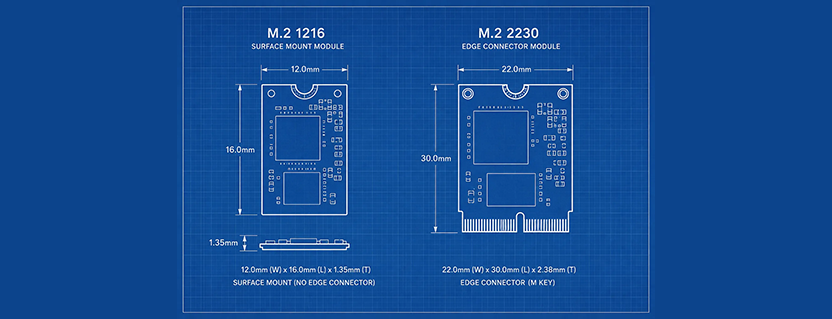
The M.2 standard provides a consistent, predictable packaging format for embedded hardware. Standardization has a long history of delivering significant advantages in technology markets, especially when considering long product lifecycle designs.
In a previous blog post, we discussed the many M.2 standard footprints, also known as the Next Generation Form Factor (NGFF), established and maintained by PCI-SIG. The M.2 standard defines more than just sizes and pinouts. It also establishes mechanical design, thermal performance, and electrical characteristics that support reliable embedded platforms.
It is not simply another shape or connector format. It is about reliability and engineering best practices that manufacturers can leverage in their designs.
Although the standard was initially designed for PC peripherals such as wireless cards and SSDs, it has become increasingly popular for embedded computing applications. In particular, the M.2 1216 SMT, M.2 1218 SMT, and M.2 2230 pluggable form factors are widely used in embedded wireless designs.
These form factors are central to Ezurio’s embedded wireless portfolio and long-term engineering roadmap.
Choosing wireless hardware depends on application requirements, environmental conditions, PCB space limitations, and future upgrade plans.
Ezurio provides OEMs with access to leading Wi-Fi chipsets using M.2-standardized form factors that align with different design needs.
Each Wi-Fi radio family includes M.2 1216 and/or 1218 SMT modules while also offering corresponding M.2 2230 pluggable versions using the same RF chipset. This allows designers to maintain RF performance while selecting the most suitable form factor.
The SMT nature of M.2 1216 and 1218 modules offers rugged integration advantages, including improved resistance to vibration, dust, and shock. Solder-down designs also provide validated durability for harsh environments.
However, pluggable M.2 2230 modules offer easier field upgrades and long-term flexibility. For products expected to remain deployed for a decade or more, the ability to replace wireless modules without redesigning the hardware can be a significant advantage.
This is particularly useful in medical equipment, indoor gateways, sensors, and other stable operating environments where future-proofing may outweigh ruggedization requirements.
M.2 SMT modules provide the same RF chipset and core radio hardware as their larger M.2 2230 counterparts, allowing space-constrained devices to maintain full wireless performance.
Ezurio also offers integrated chip antenna options on M.2 1216 and 1218 modules, expanding integration flexibility.
The M.2 specification supports multiple antenna approaches, including on-module connectors, RF pins, and integrated antennas, while maintaining compatibility between devices.
This allows OEMs to move between modules without redesigning RF paths or antenna placement in their end products.
Ezurio believes that contributing to open standards provides greater long-term value than relying solely on proprietary ecosystems.
The electronics industry has historically suffered from fragmentation caused by proprietary connectors, interfaces, and hardware formats. Standardization reduces this complexity and improves long-term compatibility.
For embedded wireless systems, selecting a non-standard interface can create long-term limitations. If a proprietary format becomes obsolete, OEMs may be forced into costly hardware redesigns.
By using standardized M.2 form factors, designers gain flexibility to upgrade wireless technology, reduce costs, and adapt to changing application requirements without redesigning the base hardware.
Standardized platforms also improve long-term availability and vendor flexibility.
Ezurio supports industry standards through partnerships and participation in organizations including IEEE, Bluetooth SIG, PCI-SIG, the LoRa Alliance, the Wi-Fi Alliance, and the Zephyr Foundation.
To learn more about the Sona Wi-Fi + Bluetooth module portfolio featuring silicon from Infineon, MediaTek, NXP, Silicon Labs, and Texas Instruments, visit: https://www.ezurio.com/wifi
Courtesy of Ezurio
We use cookies to improve your experience on our site. By using our site, you consent to cookies.
Manage your cookie preferences below:
Essential cookies enable basic functions and are necessary for the proper function of the website.
Statistics cookies collect information anonymously. This information helps us understand how visitors use our website.
Google Analytics is a powerful tool that tracks and analyzes website traffic for informed marketing decisions.
Service URL: policies.google.com (opens in a new window)
Google reCAPTCHA helps protect websites from spam and abuse by verifying user interactions through challenges.
SourceBuster is used by WooCommerce for order attribution based on user source.