
When it comes to managing fleets and other mobile assets, more is better, but less also is more. This isn’t a brain teaser but rather two tips for engineers to keep in mind when designing solutions for public safety, trucking, logistics, and other transportation verticals.
First, the more-is-better aspect: The combination of LTE, LPWAN, and GNSS provides the connectivity and positioning, navigation, and timing (PNT) capabilities and options that most fleet management and asset tracking applications require. And for each of those technologies, there are multiple bands and networks/constellations that can be combined to maximize the performance and resilience of the management and tracking applications using them.
Wideband LTE antennas provide the most flexibility, roaming opportunities, and future proofing for engineers and end users alike because they cover all of the 4G bands and operator networks between 600 MHz and 6 GHz. That means they also support all of the LPWAN technologies that use licensed spectrum: NB-IoT (LTE Cat-NB), LTE-M (LTE Cat-M), and LTE Cat 1bis. (For a deeper dive, see “Choosing the Right LTE Standard for IoT Applications” and “LTE Cat 1 bis Explained: The Future of IoT Connectivity.”)

Some businesses, such as utilities, prefer to own and operate a cellular network. When designing solutions for that sector, choose an antenna that covers LTE Band 106 (896-901 MHz uplink and 935-940 MHz downlink). For example, all Taoglas antennas that cover LTE Band 8 (880-915 MHz uplink and 925-960 MHz downlink) will support B106, too. (For more insights, see “B106/n106: The New 900 MHz Option for Private LTE and 5G Networks for Utility Applications.”)
If the target markets include public safety, focus on antennas that cover LTE Band 14, which is home to FirstNet networks. (For more information, see “Top Public Safety Communication Trends and Technologies in 2026.”)
GPS signals are already relatively weak by the time they reach the Earth, and they’re frequently attenuated even more by dense foliage and concrete canyons. Obviously that’s problematic for tracking vehicles and assets, especially high-value ones such as a shipping container full of TVs.
Hence the business case for augmenting GPS with one or more additional GNSS constellations, such as GLONASS and Galileo, depending on factors such as where on Earth those vehicles and assets travel. That means the GNSS antenna must support all of the frequencies that each constellation uses. (For more insights, see “GNSS vs. GPS: What’s the Difference?” and “GNSS Constellations: Exploring GPS, GLONASS, Galileo, BeiDou, NavIC, and QZSS.”)
Now for the less-is-more aspect. When antennas are visible, they call attention to the fact that they’re used for something, which can make them a target. For example, cargo or vehicle thieves will look for antennas and then disable or remove them to prevent tracking. In the case of law enforcement, anything more than a shark fin is a sure sign of an undercover operation for those who know what to look for.
Cost and reliability are two more reasons for minimizing antenna counts. Every additional one is a hole that must be drilled and a potential ingress point for water that can damage connectors, cables, and whatever is inside the vehicle or asset. And if that vehicle will eventually be decommissioned and sold — which is common with police cruisers, for example — every hole must be sealed before sale. That process takes time and thus money.
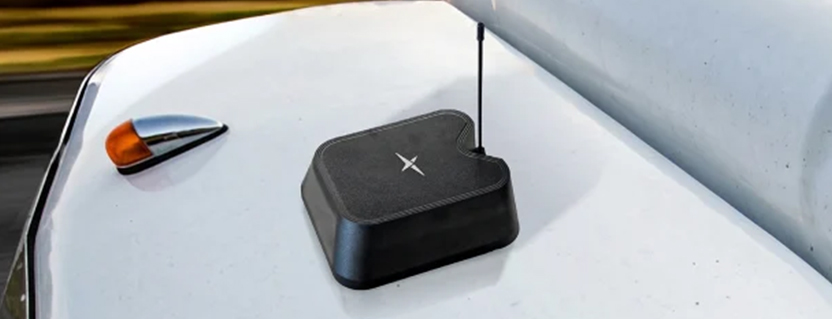
These costs and considerations are among the reasons why fleet owners and other end users prefer solutions that consolidate LTE, LPWAN, and GNSS antennas into a single enclosure. The’re also the reasons why Taoglas developed the Patriot series, a compact, roof-mount antenna designed for first responder agencies and other fleets. Measuring just 205 mm long by 180 mm wide, a single Patriot enclosure accommodates up to 18 antenna elements for:
With the Ford Interceptor, for example, installers simply remove the existing OEM shark fin antenna and replace it with the Patriot enclosure. The Patriot series includes a custom-engineered foam gasket to ensure a perfect seal between the enclosure and the curved vehicle roof. (For more information about the Patriot, see “Fairfax County Police Hide Their Antennas in Plain Sight” and “Overcoming Cellular and GNSS Antenna Placement and Installation Challenges for Public Safety.”)
Consolidating antennas means that all of those services now use not only a single enclosure, but also fewer connectors and cables. All of those components must be ruggedized to withstand years of temperature extremes, the sun’s heat and UV rays, rain, ice, and dust, as well as constant vibration while the vehicle or asset is on the road.
When comparing enclosures, focus on their IP and IK specs. For example, all Patriot models have at least an IP67-rated enclosure, which means they’ve been verified to withstand up to 1 meter submersion for 30 minutes. Their enclosures also have an IK08 rating, which measures protection against a hailstone or other mass weighing up to 1.7 kg dropped from a height of 29.5 cm. (For a deeper dive, see “What Does an IP67 Rating Really Tell You about an Antenna’s Durability?” and “How IP and IK Ratings Measure Real-World Durability” )
Two potential weak links are the cables and connectors. When they’re ruggedized, they provide additional layers of protection if the enclosure gasket is compromised. The cable’s shield and jacket layers should be thick enough to protect the conductor against liquids, including when it freezes, yet flexible enough to route easily. The connectors also should be ruggedized and, during manufacturing, tested to verify that they’re sealed tight against the cable ends. (For more insights, see “A Crash Course on RF Cables” and “What’s Inside is What Counts: Understanding Antenna Coaxial Cables.”)
Taoglas has extensive experience with a wide variety of fleet management and asset tracking applications. To learn more, see:
Get in touch for orders or any queries: sales@rfdesign.co.za / +27 21 555 8400
Courtesy of Taoglas