

Safe and reliable positioning solutions powered by u-blox safety engineered GNSS products.
Safety is a core differentiator for positioning solutions that operate in safety‑critical environments such as automotive and agricultural automation. This technology page summarizes why safety matters, what safety engineering means in practice, and how safety considerations translate into the development and validation of safe GNSS products and related subsystems.
Safety is not an abstract compliance topic and not only a tick mark to comply with legal and regulatory frameworks. It is problem-oriented, use-case driven aspect that requires consideration along the whole product development lifecycle to:
Consider these examples of GNSS in automotive and agriculture safety:
These examples highlight that safety solutions must be tailored to the specific risks and requirements of each use case, ensuring that protective measures are both relevant and effective. When positioning contributes to decisions or actuation (e.g., vehicle control, automated steering, geofencing, speed limiting, machine guidance), hazards can directly affect people, property, and the environment.
High-precision GNSS (HPG) focuses on how accurate the position is, while Safe GNSS focuses on how trustworthy and safe the position is under all operating conditions. The different primary objectives might be formulated, such as:
The different scopes of high precision and safety can be compared as follows:
| Aspect | High‑Precision GNSS | Safe GNSS |
|---|---|---|
| Main goal | Accuracy | Safety & trust |
| Typical error | cm–dm | cm–dm (bounded) |
| Integrity guarantee | No | Yes |
| Fault handling | Limited | Systematic (fault detection and exclusion, integrity monitoring, diagnostics) |
| Behavior on failure | Undefined | Defined & safe |
| Safety standards | Not targeted | ISO 26262, ISO25119, ISO 21448, etc. |
| Typical use | QM automotive and agriculture, industrial, surveying, robotics | ADAS, autonomy, safety‑critical systems |
Safety is a system property that is achieved through diligent safety engineering, i.e., identifying hazards, their causal factors, and predicting the resultant severity and probability. A safe GNSS product is designed to provide positioning outputs with appropriate integrity and diagnostics for the targeted safety use case. In practice this means: clearly defined assumptions of use, robust detection of abnormal conditions, and controlled behavior when requirements are violated (e.g., alarming, output limiting, fallback, or safe state).
The UBX-A9940-KA chip and ZED-A20K module are u-blox products which are designed, developed and validated in accordance to relevant quality, safety and security standards following established safety engineering practices.
Safety engineering is the discipline concerned with ensuring that systems, products, and processes achieve an acceptable level of safety throughout their lifecycle. It identifies hazards, assesses risks, and defines measures to prevent or mitigate accidental harm. Safety engineering concentrates on
and aims to answer three key questions:
Safety engineering involves methods to systematically identify hazards, derive safety requirements, implement safety mechanisms, and demonstrate (with evidence) that residual risk is acceptable for the intended use. Some established safety analysis methods are for instance:
| Method | Purpose / key question | Typical outputs |
|---|---|---|
| HARA (Hazard Analysis and Risk Assessment) | What hazards exist in defined operating scenarios, and what risk reduction is needed? | Hazards, risk classification (e.g., S/E/C and ASIL in ISO 26262), safety goals, high‑level safety requirements. |
| FME(D)A (Failure Modes and Effects Analysis) | How can an item/function fail, what are the effects, and how do we detect/mitigate it? | Failure modes and effects, detection/mitigation actions, safety mechanisms/diagnostics, verification focus. |
| FTA (Fault Tree Analysis) | How can a top hazardous event occur (including combinations of faults)? | Fault trees, contributing fault combinations, completeness/architecture checks, support for safety case argumentation. |
Safety engineered products can handle hazardous situations through fault detection, probabilistic fault exclusion, integrity bounding, and timely failure signalization to ensure that hazardous positioning errors are either mitigated or safely indicated before use. Techniques to handle faults are usually organized as a capability chain covering the following steps
Each step builds on the previous one and may operate at different hierarchical levels like signal, satellite, constellation, sensor, or position level.
There are few primary domains which are most relevant to safety:
Safety protects against accidental harm caused by system failures, while security protects against intentional harm caused by malicious actions- and both are necessary to achieve trustworthy autonomous and GNSS‑based systems, i.e.,
This interdependence is explicitly highlighted in safety‑security co‑engineering approaches where two layers of trustworthiness are taken into account:
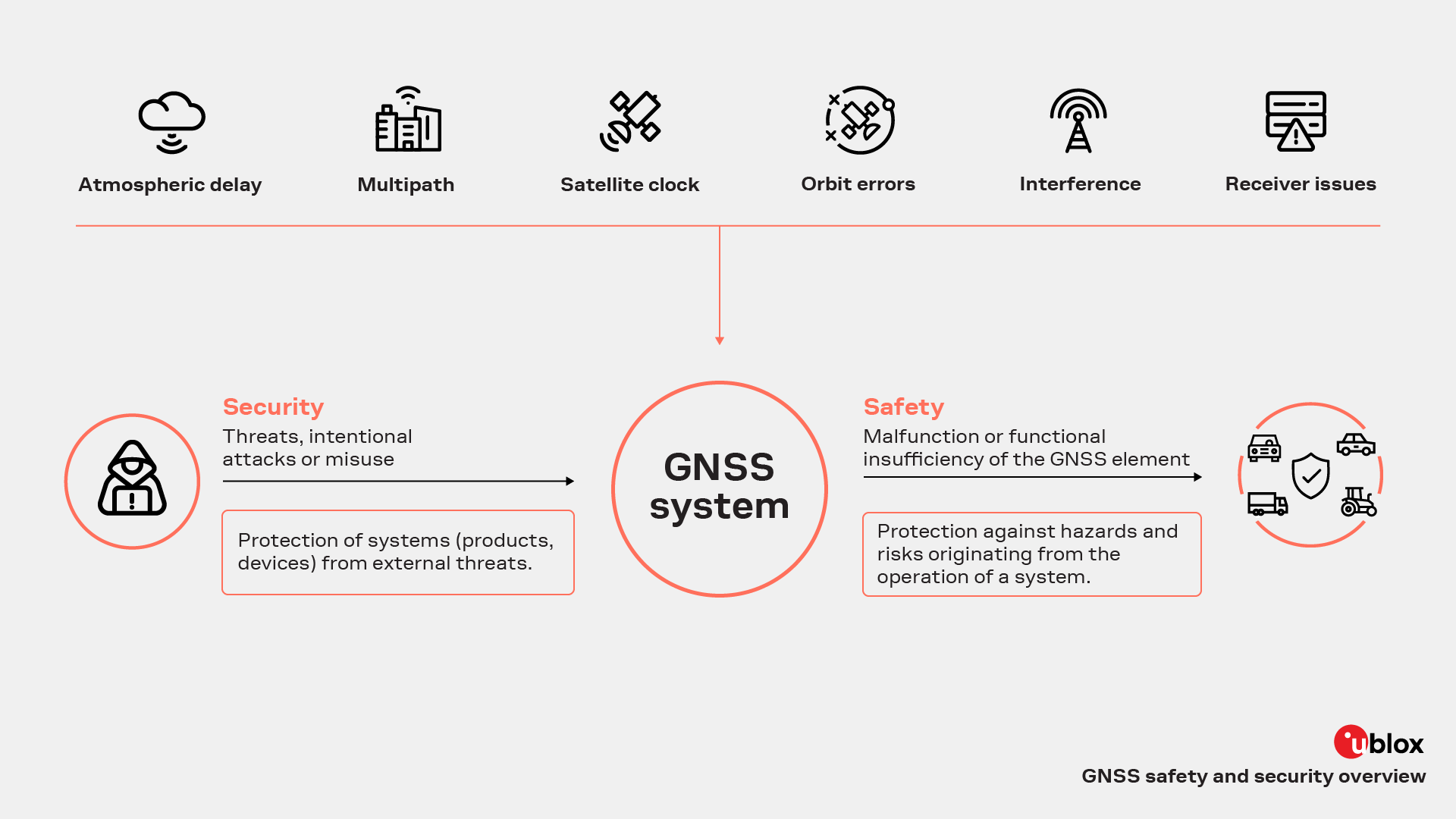
All these domains are regulated through international and industry tailored standards.
Safety is regulated by various regulations, frameworks and standards, often tailored to specific industries. Below is a short scope/purpose summary for essential regulations and standards which are relevant for safe GNSS product development:
🟩 – compliance by u-blox product(s)
🟧 – u-blox product(s) supports OEM/machine-level compliance
| Standard / Regulation | Scope (summary) | Relation to u-blox GNSS product | Status |
|---|---|---|---|
General, cross-industry regulations, frameworks and standards | |||
| EU Machinery Regulation 2023/1230 | EU legal framework defining essential health and safety requirements and conformity assessment/CE‑marking obligations for machinery and related products, with updates for digital technologies and clarifications such as “substantial modification” and “partly completed machinery.” | GNSS is typically a component; compliance is demonstrated at machine level by the OEM via risk assessment and verification/validation. | 🟧 |
| IEC 61508 | Generic functional safety standard defining a risk‑based safety lifecycle for hardware/software to achieve risk reduction via Safety Integrity Levels (SIL 1–4); basis for many sector standards. | Applies to the safety function/system, not automatically to a standalone GNSS module; the GNSS can support a SIL claim as a safety-related input with safety manual evidence, while the integrator proves SIL at system level. | 🟧 |
Quality management / Quality engineering | |||
| ISO 9001 | Quality management system requirements to consistently meet customer and statutory/regulatory requirements (process approach, risk-based thinking, performance evaluation, continual improvement). | All positioning products by u-blox comply with ISO 9001. | 🟩 |
| IATF 16949 | Automotive-sector quality management standard used with ISO 9001, adding supply-chain expectations focused on defect prevention, reduction of variation and waste, and meeting customer-specific requirements. | All positioning products by u-blox comply with IATF 16949. | 🟩 |
| Automotive SPICE® (ASPICE) | Automotive process framework for assessing and improving capability of system & software engineering, management, and support processes for software-based/E/E systems. | A9 and A20 comply with the ASPICE process framework. | 🟩 |
Automotive industry-tailored standards | |||
| ISO 26262 | Automotive adaptation of IEC 61508 specifying an automotive safety lifecycle and work products to address hazards due to E/E system malfunctions; uses ASIL A–D. | A9 and A20 comply with ISO 26262 ASIL-B(D). | 🟩 |
| ISO 21448 | Argument framework and guidance to reduce hazards from functional insufficiencies and foreseeable misuse (unsafe behavior without malfunction), complementing ISO 26262. | u-blox positioning products integrate SOTIF support features and support ISO 21448 compliance. | 🟧 |
| ISO/SAE 21434 | Engineering requirements for cybersecurity risk management across the vehicle E/E lifecycle (incl. TARA) and supporting work products; complementary to functional safety. | A9 complies with ISO 21434. | 🟩 |
Agriculture industry-tailored standards | |||
| ISO 13849 | Machinery functional safety standard for design/validation of SRP/CS using Categories and Performance Levels (PL a–e) to specify reliability of safety functions. | Applies to machine safety functions, not automatically to a GNSS module; GNSS can support the OEM’s PL target when used as a safety-related input. | 🟧 |
| ISO 25119 | Sector functional safety standard for agricultural/forestry tractors and machines for safety-related control functions implemented with E/E/PE systems; uses Agriculture Performance Level (AgPL). | A9 and A20 are ISO 26262 compliant up to ASIL‑B and therefore ready to comply with ISO 25119 up to AgPL d. | 🟩 |
| ISO 18497 | Design principles and guidance (incl. information for use/residual risks) for safety of automated/autonomous agricultural machinery during intended use and foreseeable misuse. | Addressed at automated machine function level; A9/A20 support ISO 18497 compliance via GNSS localization with defined assumptions/limits, integrity/status signaling, and integration guidance for monitoring and safe fallback. | 🟧 |
The safety role of GNSS cannot be defined in isolation. Instead, it is derived from the application‑level function, safety goals, and operational concept. The safety relevance of GNSS is not intrinsic to the technology itself but derived. GNSS is a means to an end, and its required safety contribution depends entirely on how and where its output is used within the vehicle system. GNSS requirements and integrity expectations are therefore derived top‑down from application‑level hazards, not specified bottom‑up from GNSS capabilities.
Safe positioning does not emerge from a single component, but from the orchestrated interaction of sensing, monitoring, redundancy, and decision logic. A typical GNSS positioning system setup composed of
Each element has its role and safety contribution with relevance in the functional safety, SOTIF or both domains as depicted in Fig. X.
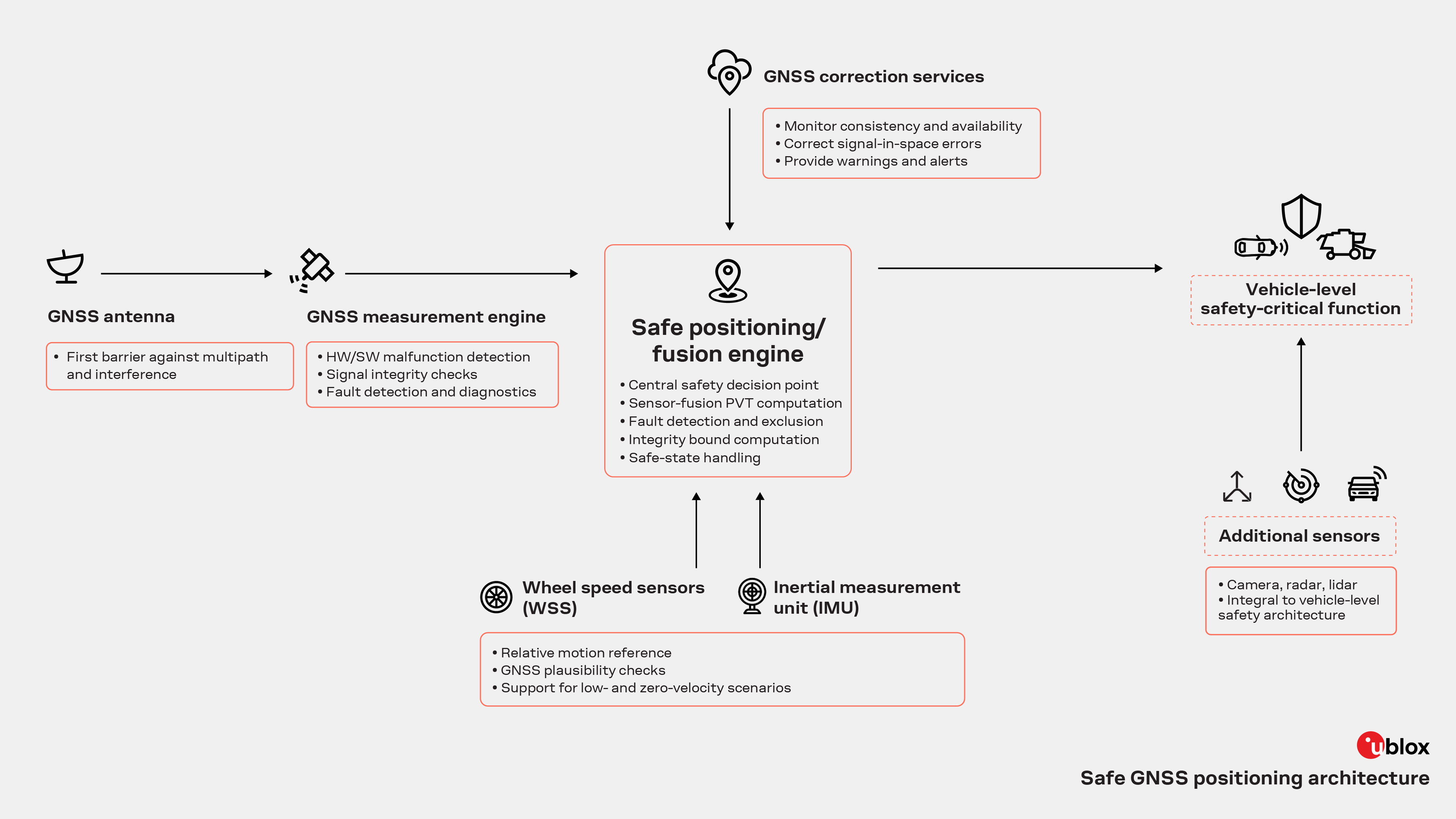
A safety‑driven development approach adds specific planning, analysis, and evidence generation on top of “standard” engineering. The objective is to ensure that safety requirements are derived from hazards, implemented with appropriate mechanisms, and verified and validated with traceable work products and documented evidence.
A generic safety‑oriented lifecycle typically includes:
For A9 and ZED-A20K functionally safe GNSS products developed at u-blox, these activities are integrated into the overall product development lifecycle through established internal safety and quality processes. The corresponding safety deliverables and supporting evidence are created throughout development.
Get in touch for orders or any queries: sales@rfdesign.co.za / +27 21 555 8400
Courtesy of u-blox